
Electronic monitoring in practice: The police response to electronically monitored bail conditions and the use of electronic monitoring on community sentences and post-release licences
Foreword (Back to top)
Electronic monitoring is playing an increasingly prominent role across the criminal justice system. Over recent years, technological advances, legislative reform and changing operational pressures have all contributed to a substantial expansion in its use. In the year to June 2026, the total number of individuals subject to electronic monitoring grew by over 2,300, to 27,847. Electronic monitoring is now expected to support a wide range of objectives, including public protection, victim safety, rehabilitation, and compliance. Against a backdrop of significant prison overcrowding, electronic monitoring is increasingly being relied upon as an alternative to custody. The introduction of the Sentencing Act 2026 is expected to accelerate this trend further, increasing both the number of people subject to monitoring and the demands placed on those responsible for delivering and responding to it.
This report brings together the findings from two strands of inspection fieldwork: the police response to breaches of electronically monitored bail conditions, and the use of electronic monitoring on community sentences and post-release licences. While they focus on different parts of the criminal justice system, both strands consider whether the governance, systems, processes and partnership arrangements supporting electronic monitoring are sufficiently mature and resilient to keep pace with its growing use.
Our inspection of the police response to breaches of electronically monitored bail conditions found dedicated officers and staff working hard to respond to a substantial and increasing demand. Yet national guidance was limited, and systems and processes in different fieldwork forces varied considerably. In the cases we examined, alleged breaches of electronically monitored bail conditions did not consistently lead to structured consideration of risk to victims, witnesses or the wider public. Poor record-keeping, information-gathering and analysis made it difficult for forces to understand either the demand generated by electronic monitoring or the effectiveness of their response.
For probation, electronic monitoring has expanded the range of tools available to support public protection and risk management. Regional electronic monitoring teams have improved oversight, strengthened governance and brought greater expertise to the management of increasingly complex monitoring arrangements. However, expansion has brought complexity. Across the Probation Service, practitioners are required to navigate a growing range of monitoring technologies, operating models and communication channels. While many recognise the potential value of electronic monitoring, it is not always fully integrated into supervision or rehabilitative work. We found examples of monitoring data being underused and practitioners receiving large volumes of information without always having the confidence or capacity to make best use of it. Many of the challenges identified in our 2022 inspection of electronic monitoring remain evident today.
A particular concern is that, despite significant investment in data systems and management information, achieving a reliable picture of electronic monitoring activity still requires substantial manual effort. On 30 June 2026, there were 5,043 individuals who should have been subject to electronic monitoring but were not being monitored.
Understanding who is subject to EM, who remains unassigned with the necessary equipment, and the reasons for this, often relies on the reconciliation of multiple datasets and validation exercises. As electronic monitoring continues to expand, the need for a single, trusted and accessible source of information becomes increasingly important for management of the caseload and public confidence.
Most concerningly, both inspection strands identified risks arising from fragmented information-sharing arrangements. Whether between probation and the Electronic Monitoring Service (EMS), police and courts, or across different information systems, the absence of clear, timely and reliable information frequently undermined confidence in monitoring arrangements.
Our probation inspection findings also raise important questions about fairness and equality. While national policy recognises that electronic monitoring should be applied equitably, we are yet to see mature arrangements for understanding disproportionality across protected characteristics. As the use of electronic monitoring grows, it will become increasingly important for criminal justice agencies to understand not only who is being monitored, but whether its use and outcomes differ for particular groups.
At its best, electronic monitoring offers opportunities to strengthen public protection, improve victim safety and support more effective supervision and monitoring in the community. These tools have the potential to be guard-rails, steering people away from the wrong choices. However, technology alone cannot deliver these outcomes. Success depends on the quality of the supporting systems, partnerships, governance and professional practice that sit around it.
As electronic monitoring assumes a more prominent role within the criminal justice system, the focus must shift from expanding its use to ensuring it is delivered consistently, effectively and in ways that achieve the intended benefits for victims, communities and those subject to monitoring. This report identifies examples of encouraging practice, but the 30 recommendations it makes also draw attention to the scale of progress required across the system. It highlights areas where much more improvement is required if electronic monitoring is to become the credible, effective and integrated tool that policymakers, practitioners and the public expect it to be.
Martin Jones CBE
HM Chief Inspector of Probation
Michelle Skeer OBE QPM
His Majesty’s Inspector of Constabulary and Fire & Rescue Services
Contextual facts (Back to top)
Electronic monitoring – key statistics
| 27,847 | The number of individuals with electronic monitoring (EM) orders assigned with electronic monitoring equipment on 30 June 2026[1] |
| 25,533 | The number of individuals with EM orders assigned with electronic monitoring equipment on 30 June 20251 |
| 10,844 | The number of individuals assigned with EM equipment under post-release licence conditions on 30 June 20261 |
| 9,423 | The number of individuals assigned with EM equipment under post-release licence conditions on 30 June 20251 |
| 3,914 | The number of individuals assigned with EM equipment being electronically monitored as part of community orders or suspended sentence orders on 30 June 20261 |
| 3,455 | The number of individuals assigned with EM equipment being electronically monitored as part of community orders or suspended sentence orders on 30 June 20251 |
| 8,970 | The number of individuals assigned with EM equipment subject to electronically monitored bail on 30 June 20261 |
| 8,392 | The number of individuals assigned with EM equipment subject to electronically monitored bail on 30 June 20251 |
Types of electronic monitoring – key statistics
| 16,034 | The number of individuals assigned with EM equipment being monitored via GPS tags on 30 June 20261 |
| 8,241 | The number of individuals assigned with EM equipment being monitored via radio frequency curfew tags on 30 June 20261 |
| 5,130 | The number of individuals assigned with EM equipment being monitored via alcohol monitoring tags on 30 June 20261 |
Individual not assigned with EM equipment – key statistics
| 5,043[2] | The number of individuals with electronic monitoring orders in place but not assigned equipment on 30 June 2026[3] |
| 2,704 | The number of individuals with electronically monitored bail in place but not assigned equipment on 30 June 20265 |
| 1,585 | The number of individuals with post-release licence conditions in place but not assigned equipment for electronic monitoring on 30 June 20265 |
| 608 | The number of individuals with community orders or suspended sentence order requirements in place but not assigned equipment for electronic monitoring on 30 June 20265 |
Executive summary (Back to top)
This inspection examined the police response to electronically monitored bail conditions and the effectiveness of electronic monitoring (EM) used by the Probation Service. The inspection of electronically monitored conditions was undertaken across two police forces and involved a review of force documentation, examination of 21 alleged breach of EM bail cases, and interviews and focus groups with relevant police personnel. Evidence was supplemented by analysis of all 43 force management statements for 2025 and interviews with national stakeholders.
The probation fieldwork included inspection of 180 cases across six probation delivery units in six regions, alongside interviews and focus groups with staff and stakeholders in each area. A further week of interviews was conducted with national stakeholders to explore electronic monitoring policy, strategy and operational delivery.
The scale and nature of electronically monitored bail conditions
The inspection found that police forces face substantial and growing demand for police action arising from electronically monitored bail conditions. The National Police Chiefs’ Council (NPCC) EM lead told us that the introduction of the Sentencing Act 2026 and the accompanying changes to the Bail Act 1976 were likely to have a significant impact on the volume of notifications about alleged EM bail breaches.
The Ministry of Justice (MoJ) has forecast a large increase in the number of individuals with EM bail conditions by 31 March 2029. If the number of EM bail breach notifications sent to forces rose at the same rate, this would result in a large increase in police workload. We believe there are opportunities to reduce some of this workload by changing the rules by which the police are told about some alleged EM bail breaches.
The police are expected to inform the Electronic Monitoring Service (EMS) of the action taken in response to each EM bail breach notification. Owing to poor record-keeping and data inaccuracies, we were unable to determine what enforcement action, if any, had been taken in the majority of cases.
Overall, we conclude that the MoJ should publish more information on EM bail conditions to enable the public and other interested parties to better understand their nature and scale, identify what is working well, and highlight areas where improvement is needed.
Policing arrangements
While the national leadership arrangements were well structured, there was limited guidance available to support this work. As a result, the approaches adopted by the forces we visited varied considerably.
The quality of information provided to forces presented significant challenges. Police forces reported frequent inaccuracies in the information received from the EMS and often had to carry out their own validation checks before making enforcement decisions.
The forces visited during fieldwork did not have effective systems for recording EM bail breach notifications. Consequently, they were unable to understand the volume and nature of their response, assess the demands placed on the force, or identify and manage associated risks to the public. Neither force had developed sufficiently mature performance management or scrutiny arrangements to provide effective oversight of this work.
Police response to the Ministry of Justice Electronic Monitoring Court Bail Protocol
The inspection found that the arrangements for managing and responding to EM bail breach notifications were not always operating in the best interests of victims and were not being applied consistently across police forces.
A particular concern was the absence of structured risk assessments. Although the Ministry of Justice Electronic Monitoring Court Bail Protocol requires forces to assess risk when responding to EM bail breach notifications, we found limited evidence that this was being done consistently. As a result, it was not always clear whether victims’ safety and safeguarding considerations had informed enforcement decisions.
We found that safeguarding referrals were not always made when EM bail breach notifications were about children. We also found that forces did not consistently record the rationale for decisions about enforcement action. This limited transparency and made it difficult to assess whether appropriate decisions had been made.
Police officers told us that defendants arrested for alleged EM bail breaches were sometimes released by the courts subject to the same conditions they had previously breached. We were told that this could occur repeatedly, and our fieldwork case assessments identified examples of this.
While we observed some examples of innovative and effective practice, the overall picture suggests that police systems and processes have not kept pace with the increasing scale and complexity of EM bail arrangements. As a result, forces are not always able to respond to breaches in a consistent, risk-informed and victim-focused way.
Victim contact
The Ministry of Justice Electronic Monitoring Court Bail Protocol and the Victims’ Code do not require the police to inform victims about alleged EM bail breaches. However, we consider it important that victims are updated in appropriate cases about alleged breaches and any action taken by the police in response. This is particularly important in domestic abuse cases, where an alleged breach may indicate an increased risk to the victim’s safety.
Our inspection also found that, in some cases, victims were not informed of the outcome of court bail hearings. This meant that victims were not always provided with information that could be relevant to their safety, wellbeing and ability to make informed decisions about their circumstances.
Probation service leadership, policy and strategy
Since the 2022 HM Inspectorate of Probation thematic inspection, His Majesty’s Prison and Probation Service (HMPPS) has invested significantly in the governance and oversight of EM within the Probation Service. Regional EM teams are now established in all probation regions and provide better scrutiny of cases that have not been assigned relevant EM equipment, improved oversight of violations and more support for practitioners in navigating an increasingly complex EM landscape. National leadership has also strengthened through the introduction of a new operating framework and management information products. Together, these developments have improved oversight of installation performance, enforcement activity and individuals who are not being electronically monitored as planned, with senior leaders demonstrating a stronger understanding of operational performance than was evident in our previous inspection. The availability of management information has improved considerably. However, as with policing, a recurring concern was the absence of a single, trusted source of information.
Significant manual effort remains necessary to reconcile multiple datasets and establish key operational facts, including who is currently being monitored, who is not being monitored, and why monitoring has not yet started.
The policy framework underpinning EM is comprehensive. The Electronic Monitoring Operational Framework establishes clear principles about proportionality, purpose, credibility, integration and fairness. However, many frontline practitioners were unfamiliar with some of these principles and there was little evidence that they routinely informed day-to-day decision-making.
Arrangements for understanding outcomes were less developed than those for understanding activity. In the Probation Service, leaders could generally describe performance on installations, violations, enforcement activity, monitoring volumes and breach notifications but were less able to demonstrate whether EM was contributing to reductions in reoffending, improved public protection outcomes, enhanced victim safety or better rehabilitation. We also found limited ability to understand disproportionality. While some analysis had been undertaken for specific programmes, comprehensive assurance regarding the use or impact of EM across the full range of protected characteristics was lacking.
Pre-sentence and pre-release work
Information-sharing arrangements to support decisions about EM have improved since our previous inspection. Practitioners now routinely seek police information before recommending electronically monitored curfews, which helps them to identify domestic abuse and other safeguarding concerns that may affect the suitability of a proposed address. However, the quality and completeness of information provided by police forces varied considerably. In some cases, limited information, restricted timescales for disclosure or the absence of key details reduced practitioners’ ability to make fully informed decisions and, at times, created a false sense of assurance about the suitability of curfew arrangements.
The quality of pre-sentence advice to courts was mixed. Practitioners were generally able to identify a clear purpose for EM and recommendations were usually proportionate to the seriousness of the offence. However, reports did not consistently demonstrate how EM would contribute to rehabilitation, reduce offending or work alongside other proposed requirements. Assessment of an individual’s personal circumstances, diversity needs and capacity to comply with monitoring arrangements was often insufficient. Courts imposed the recommended EM requirement in most cases, although we found examples where EM was imposed despite practitioners identifying outstanding safeguarding concerns or assessing it as unsuitable.
Sentencers were particularly positive about alcohol abstinence and monitoring requirements, describing them as a credible intervention that provided objective evidence of compliance. Beyond alcohol monitoring, however, stakeholders reported that courts continue to associate EM primarily with curfews and are often less familiar with the wider range of technologies available. While practitioners and sentencers recognised the potential value of GPS monitoring and exclusion zones, confidence in their use was variable, particularly in relation to eligibility criteria, operational requirements and practical application.
Pre-release planning was inconsistent and often gave insufficient attention to the role EM was intended to play in managing risk, protecting victims and supporting rehabilitation. While practitioners had generally considered information on safeguarding and domestic abuse, there was less evidence that they had analysed the suitability, impact and purpose of EM, or explained monitoring requirements effectively to individuals before release. Information-sharing between prisons, probation and monitoring providers was inconsistent, contributing to delays, confusion and difficulties with implementation.
The strongest practice involved early planning, effective multi-agency communication and clear discussions with individuals about the purpose and expectations of EM. However, these examples were not widespread. Too often, planning focused on the practical arrangements for imposing EM rather than how monitoring would contribute to wider sentence objectives, public protection and successful resettlement. As a result, the potential for EM to make a meaningful contribution to rehabilitation, desistance and risk management was not consistently realised.
Electronic monitoring in probation service delivery
The quality of probation practice in relation to EM was mixed and showed limited improvement since our 2022 inspection. Practitioners generally identified relevant risks, needs and personal circumstances, but too often failed to analyse how EM would contribute to reducing reoffending, managing risk, protecting victims or supporting desistance. EM was frequently treated as a stand-alone requirement rather than an integrated part of sentence management, with insufficient consideration given to motivation, ability, readiness to comply, diversity needs and personal circumstances.
Weaknesses identified in initial assessments were often carried through into planning and delivery. Too often, plans did not consistently explain how EM would support rehabilitation, public protection or wider sentence objectives. Contingency planning was particularly weak, and opportunities to involve individuals, family members and partner agencies in supporting successful compliance were frequently missed.
The delivery of EM was also hindered by operational challenges. Delays in fitting monitoring equipment remained common, communication with providers was inconsistent, and practitioners frequently reported difficulties accessing, interpreting and using monitoring information. GPS trail monitoring and exclusion zones were widely regarded as valuable public protection tools, yet both were underused. Often, practitioners were more focused on getting tags fitted than using the information they provided.
Information-sharing and multi-agency working during sentence delivery were inconsistent. Opportunities to use EM to support safeguarding, victim protection and risk management were often missed, while management oversight was effective in fewer than one-third of the inspected cases. The sharing of information about electronic monitoring requirements with victims was inconsistent, limiting assurance that victims were being kept appropriately informed. Regions had introduced specialist EM teams, and some were piloting auto-enforcement models that improved oversight and timeliness. However, these approaches raised questions about practitioners’ ownership of EM and the extent to which EM was integrated within wider case management activity.
Reviewing activity was a significant weakness. Formal review of the effectiveness and impact of EM was often absent, with limited consideration of whether monitoring had achieved its intended purpose, contributed to behavioural change or remained necessary and proportionate. Preparation for the end of monitoring was particularly poor, which reduced the opportunities to sustain progress or adapt risk management arrangements once EM had ended.
Overall, we found that EM was too often delivered as an administrative requirement focused on compliance rather than as an active intervention capable of supporting rehabilitation, reducing reoffending and strengthening public protection.
Recommendations (Back to top)
Unless otherwise stated, recommendations should be completed within 12 months.
The National Police Chiefs’ Council lead for electronic monitoring should:
- within three months, provide guidance to forces about consistent and effective ways to record electronically monitored bail breach notifications. The guidance should account for the need to manage and scrutinise the force responses
- within three months, provide more detailed guidance to forces about risk assessments when considering electronically monitored bail breach notifications. The guidance should include the need for a continuing reassessment of risk when considering subsequent electronically monitored bail breach notifications
- within three months, provide guidance for forces about when, and in what circumstances, forces should update victims about electronically monitored bail breach notifications, and work with the Ministry of Justice to include information about this in any revised Ministry of Justice Electronic Monitoring Court Bail Protocol
Chief constables should:
- immediately ensure child safeguarding referrals are made when dealing with children who are the subject of electronically monitored bail breach notifications, and include the need for child safeguarding referrals in their force policies and procedures about electronically monitored bail breaches
- immediately ensure the rationale for decisions about electronically monitored bail breach notifications are recorded in all cases, and include this in their force policies and procedures about electronically monitored bail breaches
- immediately ensure the Electronic Monitoring Service is informed in all cases about the decisions made on electronically monitored bail breach notifications
- immediately ensure that victims are told about the outcome of all bail hearings, as required by the Code of Practice for Victims of Crime in England and Wales
- following receipt of NPCC guidance, and within six months, introduce an effective way to record electronically monitored bail breach notifications
- following receipt of NPCC guidance, and within six months, ensure that victims are updated about electronically monitored bail breach notifications, and include the need to update victims about electronically monitored bail breach notifications in their relevant force policies and procedures
- within six months, have in place effective ways to manage and scrutinise their force’s response to electronically monitored bail breach notifications
- within six months, make sure that their force management statements include an assessment of the demand created by electronically monitored bail breach notifications. The assessment of demand should account for the projected effects of the Sentencing Act 2026
The Ministry of Justice and National Police Chiefs’ Council lead for electronic monitoring should:
- within six months, the Ministry of Justice and the NPCC lead for electronic monitoring should work together to introduce a better, automated way for gathering information on decisions made by forces about electronically monitored bail breach notifications
- within three months, the Ministry of Justice and the NPCC lead for electronic monitoring should work together to agree a process whereby the Electronic Monitoring Service sends notifications about electronically monitored bail breaches to the force where the defendant was charged with the offence(s) for which bail conditions were imposed
- within three months, the Ministry of Justice and the NPCC lead for electronic monitoring should work with other interested parties to review the Ministry of Justice Electronic Monitoring Court Bail Protocol, and decide whether the current types of electronically monitored bail breach notifications that are sent to forces are still relevant and proportionate
The Ministry of Justice should:
- establish clear senior accountability for the end-to-end electronic monitoring system, setting out responsibility for driving performance, coordinating partners, managing risk and overseeing delivery across the criminal justice system
- publish more detailed information about electronically monitored bail breach notifications and the results of these – as a minimum, this information should include:
a)the number of children subject to electronically monitored bail conditions
b)the number and type of electronically monitored bail breach notifications, including by police force area
c)a summary of police enforcement decisions
d)a summary of court decisions - within three months, assure itself that the Electronic Monitoring Service can meet the demand for external agency requests, including any anticipated future demand from forces
- develop and implement a framework for the ongoing evaluation of electronic monitoring, assessing its effectiveness in improving public protection, supporting rehabilitation, enhancing victim safety, and reducing reoffending
- include data on the reliability of electronic monitoring equipment, including equipment failures, in the electronic monitoring statistics publication
- ensure that accurate data on all aspects of electronic monitoring is collated and analysed to inform how it is being applied and developed, including strategic analysis of sentencing and prison release data and information on demographics and protected characteristics
His Majesty’s Prison and Probation Service should:
- Simplify electronic monitoring operational processes, including:
a)providing all probation practitioners with access to the Electronic Monitoring Service request portal and ceasing use of the multiple Electronic Monitoring Service inboxes
b)ensuring that electronic monitoring providers supply accurate, complete and timely notifications, supported by robust quality assurance processes and clear accountability for data quality
c) implementing automated processes for recording electronic monitoring notifications on probation case management systems, reducing the need for manual data entry - strengthen the end-to-end process that ensures licence conditions are accurately translated into electronic monitoring instructions that are visible to probation practitioners – this process should be supported by processes and terminology that are aligned across all platforms involved, to minimise the risk of human error
- expedite the roll-out of the EM Data Insights tool so that probation practitioners can easily access and analyse up-to-date electronic monitoring data for the cases they manage
- ensure that GPS trail monitoring is available nationally as part of the management of people convicted of sexual offences, domestic abuse, stalking or posing a high risk of serious harm, regardless of the type of licence they are released under
- ensure that domestic abuse information requested by probation practitioners is tailored to the individual risks and needs in the case and covers a suitable timeframe to support robust assessments in relation to the suitability of curfews
- add electronic monitoring training to the required learning for probation practitioners and senior probation officers and ensure that they have the necessary skills, knowledge and support required to use electronic monitoring effectively
- improve risk management planning to ensure electronic monitoring is fully embedded, reflects its restrictive and constructive purposes, and provides a meaningful contingency plan to mitigate risks specific to the individual when electronic monitoring fails
- ensure that where an electronically monitored exclusion zone is proposed, the responsible practitioner provides a clear map of the relevant area with the pre-sentence report to court or proposed licence conditions to the prison
- revise the process for supplying the Electronic Monitoring Service with information on risk to ensure this information is received before monitoring equipment is fitted
- ensure all suspected faults with electronic monitoring equipment are reported and an outcome is recorded on case management systems.
Report outline (Back to top)
This report is presented in two parts. Part one, led by His Majesty’s Inspectorate of Constabulary and Fire & Rescue Services (HMICFRS), examines the police response to breaches of electronically monitored bail conditions. Part two, led by HM Inspectorate of Probation, examines the use of EM on community sentences and post-release licences. As the fieldwork for each aspect of the inspection was undertaken separately and at different times, the findings are reported in two distinct parts.
| Chapter | Content |
| Introduction | This chapter sets the context for the inspection, outlining the growth and development of EM since 2022, including legislative reforms, technological advances and increasing policy ambition. It explains the rationale for the inspection, reviews previous inspection findings and research evidence, and describes the scope, aims and methodology of the inspection. |
| Part 1: The police response to breaches of electronically monitored bail conditions | |
| Introduction to police responses to breaches of electronically monitored bail | This chapter sets out the rationale for inspecting the police response to breaches of electronically monitored bail conditions and provides the necessary background and context. It describes court bail processes and the role of the Bail Information Service and explains the arrangements for electronic monitoring of individuals subject to court bail conditions. |
| Policing arrangements | This chapter considers the strategic framework supporting the police response to breaches of electronically monitored court bail conditions. It examines national police leadership and guidance, reviews police responsibilities under the Ministry of Justice Electronic Monitoring Court Bail Protocol and assesses national and local information, performance management and arrangements to assess demand in supporting operational delivery. |
| Police response to the Ministry of Justice Protocol | This chapter assesses the police response to breaches of electronically monitored court bail conditions, from the receipt of notifications through to risk assessment, enforcement decision-making and information-sharing. It examines the effectiveness and consistency of police processes and considers the impact of current arrangements on victim safety, safeguarding, operational performance and outcomes. |
| Victim contact | This chapter examines how effectively victims are kept informed about breaches of electronically monitored court bail conditions and related court proceedings. It considers the requirements of the Victims’ Code, the role of police forces and witness care units in communicating with victims, and the extent to which current practice supports victim safety, safeguarding and confidence in the criminal justice system. |
| Part 2: The use of electronic monitoring on community sentences and post-release licences | |
| Probation service leadership, strategy and policy | This chapter examines the leadership, governance and strategic arrangements that support the delivery of EM. It reviews national and regional structures, policy, data and management information, and considers the availability and development of different forms of EM. |
| Stakeholder perspectives on electronic monitoring | This chapter explores the views and experiences of practitioners, people subject to EM and sentencers. It considers levels of confidence in EM, understanding of its purpose and use, and perceptions of its effectiveness and credibility. |
| Pre-sentence and pre-release work | This chapter sets out our findings on the quality of pre-sentence and pre-release work. It examines how effectively information is gathered and analysed to inform decisions about EM, and the extent to which planning supports public protection, rehabilitation and successful implementation of EM requirements. |
| Electronic monitoring in probation service delivery | This chapter examines the delivery of EM in practice. It considers the quality of assessment, planning, implementation, review and enforcement activity, and the extent to which EM was integrated into supervision, risk management and rehabilitation. The chapter also examines management oversight and identifies factors that supported, or limited, the effective use of EM across community and post-release licence cases. |
1. Introduction (Back to top)
1.1. Why this thematic? (Back to top)
The use of electronic monitoring (EM) has evolved significantly in recent years, in scale, purpose and complexity. Since the last HM Inspectorate of Probation thematic inspection of EM in 2022, there has been continued political and operational emphasis on expanding EM as a tool to manage risk, reduce reoffending, and enhance public protection. Ministers have pledged substantial investment, with an additional £100 million (a 30 per cent increase) to support this expansion.[4] The Police, Crime, Sentencing and Courts Act 2022 introduced new powers for probation practitioners to vary EM requirements, extended curfew limits, and broadened the scope of EM as part of community sentences and licence conditions. Electronic monitoring volumes are expected to increase substantially. Between July 2025 and June 2026, there were 79,742 new cases of EM. The Ministry of Justice estimates that up to 22,000 additional individuals could be tagged each year from 2027, an indicative increase of around 28 per cent.[5]
Technological developments have accelerated. GPS-enabled location monitoring is more widely available, not only for parole-eligible cases but also through national pilots targeting acquisitive crime and domestic abuse perpetrators. Alcohol monitoring tags, introduced nationally in 2021, are increasingly used to enforce alcohol abstinence monitoring requirements as part of community orders or alcohol abstinence or monitoring conditions on licences. Early evaluations suggest they can support behaviour change beyond a punitive intent. These innovations have created new opportunities and challenges for integrating EM into sentence planning and risk management. Operational delivery has also shifted. The unification of probation services in 2021 aimed to embed EM within a single service model.
The scale of EM use has grown dramatically. On 20 June 2026, there were 27,847[6] individuals assigned with EM equipment across England and Wales, including those on bail, community orders, and post-release licences. The expansion raises critical questions about proportionality, effectiveness and equity.
In the 2022 inspection, we made 17 recommendations, of which 14 were fully agreed and three partly agreed. The last action plan update from May 2025 showed that actions against the majority of these recommendations were marked as completed, including improvements to policy, operational frameworks, training, and enforcement processes. However, several actions remained outstanding, primarily those dependent on new EM contracts and data infrastructure. These include full delivery of reporting on demographics and protected characteristics, real-time data access for probation practitioners, and improvements to the integration of systems. This inspection offered an opportunity to test the impact of the actions.
Given the significant expansion of EM in recent years, a further thematic inspection was necessary to assess progress and determine how well the Probation Service and partner agencies are positioned to manage the anticipated increase in demand.
This inspection also examines, for the first time, the police response to breaches of electronically monitored bail conditions. The use of EM bail has increased significantly and is expected to expand further in response to changes in sentencing policy and legislative reform. Despite its growing importance as a tool to support court decisions, manage risk and protect victims while cases progress through the courts, this aspect of EM has not previously been subject to independent inspection. The inspection therefore considers whether current arrangements are effective, whether agencies are prepared for the anticipated growth in demand, and how well risks to victims and the public are being managed.
The inspection provides an up-to-date assessment of the delivery of EM within probation practice, examining the extent to which legislative reforms, technological developments and service redesign have translated into improved public protection, risk management and rehabilitative outcomes. It also considers whether the operational infrastructure, workforce capability and partnership arrangements are sufficient to support the continued growth of EM.
1.2. Background (Back to top)
EM has been part of the criminal justice system in England and Wales for more than three decades. Electronically monitored curfews, using radio frequency (RF) technology, were first introduced through the Criminal Justice Act 1991. The national expansion of EM began in 1999 alongside the introduction of the home detention curfew (HDC) scheme, which enabled eligible prisoners to be released early from custody subject to electronically monitored curfew restrictions in the community. Under HDC arrangements, EM was viewed as a means of supporting public protection while facilitating a managed transition from custody to the community.
The Criminal Justice Act 1991 enabled courts to impose electronically monitored curfews as a sentencing option, requiring individuals to remain at a specified address for defined periods. Legislative developments through the Criminal Justice Act 2003 established EM as a requirement that could be attached to community orders and suspended sentence orders. Further amendments through the Crime and Courts Act 2013 broadened the potential use of EM by providing for location monitoring and compliance monitoring, reflecting a move beyond simple curfew enforcement towards more sophisticated forms of behaviour and risk management.
EM was first piloted as a condition of bail in the late 1990s. Following a series of pilot programmes and evaluations, amendments to the Bail Act 1976, introduced through the Criminal Justice and Immigration Act 2008, provided a statutory basis for the routine use of EM on bail and enabled its roll-out across England and Wales from 2008.
Over time, the range and complexity of EM have increased substantially and evolved into a broad suite of technologies that now includes GPS trail monitoring, exclusion zone monitoring, alcohol monitoring, and offence-specific monitoring schemes. More recently, EM has become an increasingly prominent feature of government policy aimed at reducing reliance on custody, supporting public protection and managing rising demand across the criminal justice system.
A significant development was the introduction of the alcohol abstinence and monitoring requirement (AAMR) through the Legal Aid, Sentencing and Punishment of Offenders Act 2012. Following pilots, Wales became the first area to implement the requirement before national roll-out across England from March 2021. AAMRs require individuals to abstain completely from alcohol, with compliance monitored remotely through transdermal alcohol monitoring technology. The introduction of alcohol monitoring reflected a broader policy ambition to increase confidence in community-based sentences while providing courts and the Probation Service with additional tools to manage offending behaviour linked to alcohol misuse.
Government policy has continued to signal an intention to expand the use of EM. Successive policy documents and legislative reforms have promoted EM as a credible alternative to custody and as a mechanism for managing or monitoring individuals in the community. These developments have been accompanied by technological advances, including the expansion of GPS monitoring, domestic abuse monitoring arrangements, acquisitive crime monitoring schemes, tagging-at-source initiatives, and the establishment of regional EM teams within the Probation Service.
HM Inspectorate of Probation has previously examined EM through thematic inspections in 2008, 2012 and 2022. The earlier inspections focused primarily on electronically monitored curfews and HDC arrangements. The 2008 inspection found significant weaknesses in communication between courts, the Probation Service and monitoring providers. Information was frequently late, incomplete or inaccurate, and there was no national consistency in the information that was required to begin monitoring. The 2012 inspection found some improvement, including the introduction of national forms by HM Courts and Tribunals Service (HMCTS), but communication between agencies remained problematic and responsibilities were often unclear.
The most recent thematic inspection, The use of electronic monitoring as a tool for the Probation Service in reducing reoffending and managing risk (2022), examined EM at a point when GPS technology and alcohol monitoring were beginning to expand nationally. We concluded that EM was not being used to its full potential and was often regarded as an additional requirement rather than an integral part of supervision, sentence management and risk management. Practitioners frequently viewed EM primarily as a tool for monitoring compliance, rather than as a means of supporting rehabilitation, strengthening public protection or informing professional decision-making.
The 2022 inspection also found that practitioners did not consistently use monitoring information to inform assessments, risk management plans or supervision activity. Access to monitoring data was often limited, practitioners’ confidence in the different forms of EM varied considerably, and there was uncertainty about the purpose and application of newer technologies. Although examples of good practice were identified, EM was rarely embedded in a way that enabled it to contribute fully to sentence management, behaviour change or public protection.
Previous inspections identified a number of systemic barriers. These included delays in fitting equipment, weaknesses in communication and information-sharing between the Probation Service and monitoring providers, inconsistent use of monitoring information, and the absence of a sufficiently clear strategic framework for integrating EM into probation practice. We concluded that EM worked best when it formed part of a broader package of supervision and rehabilitative support and recommended improvements to practitioner training, access to monitoring information, and a better organisational understanding of EM’s role within offender management.
Research evidence continues to suggest that EM can provide important benefits while monitoring is active, particularly when individuals are motivated to make changes in their lives (Hucklesby and Holdsworth, 2020). EM is most effective when it is combined with wider supervision, interventions and support rather than used as a stand-alone mechanism for controlling behaviour (Hucklesby, 2025; Williams et al., 2022). Studies have found that EM can introduce structure, support compliance, provide reassurance to victims and create opportunities for practitioners to engage individuals in rehabilitative work. However, the evidence regarding longer-term reductions in reoffending remains mixed (Bruton-Smith, 2005a; Bruton-Smith, 2005b). In addition, for some individuals, EM can have a negative impact on family relationships, employment and other pro-social activities (Hucklesby and Holdsworth, 2025). For these reasons, the use of EM needs to be proportionate to the risks and needs in each individual case.
The period since the 2022 inspection has been characterised by substantial change. Regional EM teams have been established across probation regions, new operating models have emerged, and significant investment has been made in GPS monitoring, alcohol monitoring, implementation pilots and data systems. At the same time, EM has assumed an increasingly prominent role in government policy, with further expansion anticipated through sentencing reform and wider efforts to manage demand within the criminal justice system.
During our fieldwork, the National Audit Office (NAO) published its report Electronic monitoring: improving resilience to meet increasing demand (2026). It concluded that, although HMPPS had successfully expanded EM, the system was not yet operating as intended and remained affected by weaknesses in governance, data quality, performance oversight and system-wide accountability. Our findings were consistent with many of the issues identified by the NAO.
1.3. Aims and objectives (Back to top)
In relation to electronically monitored court bail, we sought to answer the following question:
- How effective is the police response to breaches of electronically monitored bail conditions?
For probation work, the inspection sought to answer the following questions:
- Does leadership support and promote the delivery of a high-quality, personalised and responsive service for all individuals subject to EM?
- Are staff working within probation empowered to deliver a high-quality, personalised and responsive service to those supervised by EM as part of their sentence?
- Is there a high-quality service in place, supporting a tailored and responsive service for all those subject to EM?
- Is timely, relevant, and analytical information available to support a high-quality, personalised and responsive EM service?
- How well does EM support desistance from offending?
- How effective is EM at keeping people safe?
The scope of this inspection included adults managed by the Probation Service and made subject to an electronically monitored requirement, either through a court order or prison licence, during the period 1 September 2025 to 30 November 2025. These included cases that were monitored via RF tags, GPS location monitoring devices or alcohol abstinence technology. Cases subject to management via the National Security Division were not included in this inspection, given the special measures for management of such cases.
The police response to breaches of electronically monitored bail conditions (Back to top)
2. Introduction to police responses to breaches of electronically monitored bail (Back to top)
2.1 The use of electronically monitored bail (Back to top)
Following a police investigation into a crime, when there is sufficient evidence, the police may charge a suspect. The police must then decide whether to bail the person to attend court on an appointed date or apply to a court to remand them in custody. The Bail Act 1976 says that a person should be granted bail unless certain provisions apply. The police cannot use EM conditions when granting bail.
If the police do not grant bail, the person should be brought before a magistrates’ court as soon as practicable and, in any event, at the first sitting after being charged.
At a court hearing, the court decides whether the person should be remanded in custody or bailed. In regard to bail, the Bail Act 1976 states that defendants may be required to abide by such requirements as appear necessary to secure that a defendant:
- surrenders to custody
- does not commit an offence on bail
- does not interfere with witnesses
- does not obstruct the course of justice or otherwise obstruct the course of justice in relation to the person or any other person.
In some circumstances, a court can impose EM requirements to monitor the bail conditions.
Following a decision to impose EM bail conditions, the court notifies the Electronic Monitoring Service (EMS), which then arranges the installation of EM equipment. Thereafter, the Ministry of Justice Electronic Monitoring Court Bail Protocol requires the EMS to monitor the individual’s compliance with the EM bail condition(s), and report breaches to the police by secure email within 24 hours. These reports of bail breaches (EM bail breach notifications) should include a pre-prepared statement suitable for prosecution purposes.
The role of the police is to arrest defendants for the alleged breaches of EM bail conditions and arrange for the defendants to be taken to court. However, it is not a criminal offence for a defendant to breach EM bail conditions.
Breaches of EM bail conditions can include the defendant:
- damaging or removing EM equipment
- tampering with the EM equipment so that the monitoring is interfered with
- breaking a curfew by 15 mins or more
- entering an exclusion zone
- failing to charge a GPS EM device battery
- refusing entry to an address for the EMS to install, maintain or check equipment
- refusing to fit or make themselves available for fitting of an EM device.
2.2 Data about EM bail and bail breaches (Back to top)
The MoJ publishes statistics about EM quarterly.[7]
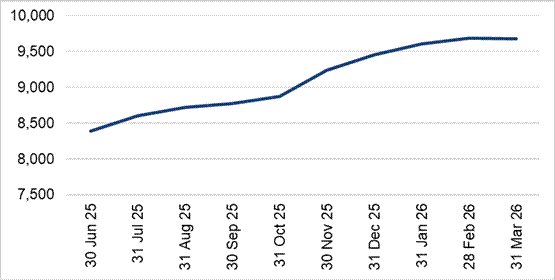
At the time of our inspection, the latest published data showed that, as of 30 June 2026, 8,970 individuals had been assigned EM equipment because of court bail.
Figure 1 shows the increase over recent months in the number of individuals assigned EM equipment because of court bail.
Figure 1: Number of individuals on court bail electronic monitoring systems in England and Wales from 30 June 2025 to 31 March 2026
Source: Electronic Monitoring System data from the Ministry of Justice.
Chart description: Line chart showing a steady increase in the number of people bailed with EM equipment over a 10-month period. As of 30 June 2025, there were 8,392 people on the system, which increased every month to 9,682 people as of 28 February 2026. As of 31 March 2026, the number of people stayed broadly the same as the previous month, at 9,674.
Note: Data for January to March 2026 are provisional. Longer time-series data are not comparable.
Each alleged breach of EM bail conditions generates an email from the EMS to the relevant police force.
The MoJ does not publish statistics on the number of EM bail breach notifications received by police forces. Doing so could help organisations and the wider public to understand the demands on policing and the criminal justice system.
The EMS shared unpublished management information data with us as part of our inspection. No figures are quoted here because the MoJ only recently obtained the data themselves. Quality assurance of this data was ongoing, and the precise figures were not ready to be shared. But this data has helped us understand the scale of demand.
The data showed many EM bail breach notifications were sent to all forces in England and Wales. The number of EM bail breach notifications varied significantly between forces.
For comparison purposes, we asked the two fieldwork forces to provide us with the number of EM bail breach notifications that they had received from the EMS. One force told us it had received 10 per cent more EM bail breach notifications than the total provided by the EMS. The other force was not able to provide us with an accurate number of EM bail breach notifications.
The MoJ has forecast a large increase in the number of individuals with EM bail conditions by 31 March 2029. If the number of EM bail breach notifications sent to forces rose at the same rate, this would result in a large increase in police workload.
We also asked the EMS to provide us with information on the number of EM bail breach notifications it had sent to forces, and how this related to the number of individuals who had EM bail conditions. This showed that each individual defendant generated multiple EM bail breach notifications in short periods of time. We found examples of this in our fieldwork. Our analysis showed that there was wide variation between forces in the number of EM bail breach notifications per individual defendant.
The police should tell the EMS what they have decided to do about each EM bail breach notification. The EMS data showed that police often had not updated the EMS about their decision on enforcement action. The number of times the police updated the EMS varied substantially by individual force. Of the times that the police did update the EMS about a decision, most were about the fact that the police had decided to take no further action.
The NPCC told us that the data about the police updates may not be accurate. This is because the EMS information system does not collate responses from forces that have been forwarded the EM bail breach notification by another force.
2.3 Sentencing Act 2026 (Back to top)
The NPCC EM lead told us that the introduction of the Sentencing Act 2026 and the accompanying changes to the Bail Act 1976 were likely to have a significant impact on the volume of EM bail breach notifications.
This is because there is now a presumption that defendants previously sentenced to less than 12 months in prison will instead serve their sentences in the community. This means it is possible that the courts may decide that more defendants should be bailed with EM conditions rather than remanded into prison awaiting trial.
We were also told that, because of the changes, if the court decided that there was no real prospect that a defendant would be given an immediate custodial sentence on conviction, the court would be required to grant them bail (with some exceptions).
The NPCC EM lead also told us that the police anticipate fewer consequences for defendants who breach their EM bail conditions. This is because the courts may be less inclined to alter bail conditions for offences that carry shorter terms of imprisonment on conviction. We discuss this further in ‘Police process after arrests made’ in section 4.3.
On 10 July 2026 the NAO published its report Electronic monitoring: improving resilience to meet increasing demand (NAO, 2026). This stated that in September 2025, before implementation decisions were finalised, the MoJ estimated that the projected net increase included around 8,000 more court bail cases (reflecting expanded powers to impose EM and an increasing court backlog).
The NPCC told us that changes should be made to some requirements for the EMS to notify police forces about alleged EM bail breaches. For example, the 15-minute time limit before EM curfew breach notifications are generated could be increased. The NPCC told us that making these changes should reduce the volume of EM bail breach notifications received by forces. We believe this should ensure that police forces are more able to focus on those defendants who pose the greatest risk to the public.
The MoJ told us that the requirements for the EMS to notify police forces about alleged EM bail breaches are ‘business rules’ contained in the MoJ protocol. As such, any changes could be agreed between the parties subject to the protocol. The current rules had been agreed by those parties, including the NPCC, prior to the introduction of the protocol.
We believe there are opportunities to review and change some of the MoJ protocol business rules by which the police are told about some alleged EM bail breaches, and we have made a recommendation about this.
2.4 Initial bail process (Back to top)
Once the police have decided to charge a defendant, they are required to send information to the Crown Prosecution Service (CPS) before a first court appearance. The information is called a prosecution case file, and is made up of several different forms. Exactly which forms are required in which circumstances is dictated by the National File Standard.[8]
When the police want to ask the court to consider remanding the defendant, the police should submit this information on an ‘MG7 form’. In general, the information in the MG7 form should:
- allow the CPS (and the court) to understand why the police have refused bail
- ask the CPS prosecutor to apply for a remand in custody (or, in different circumstances, on conditional bail)
- inform the CPS prosecutor of the specific grounds on which the remand application is sought
- provide information to the CPS prosecutor about what bail conditions would be appropriate should the court decide not to remand the defendant into custody.
It is important that the CPS and the courts have the best and most comprehensive information available when considering bail. Without the right information, the court may impose bail conditions that are unsuitable. For example, an address may be unsuitable for EM because the owner of the property is unwilling to have the equipment installed. If this happens, the EMS notifies the police, which generates the police response to the EM bail breach notifications that we describe in ‘Police response to the Ministry of Justice protocol’. (section 4).
It is also important that officers have effective ways of providing information to the CPS about how EM could be relevant to the case. This includes ways of prompting officers to include this information in MG7 forms, and guidance and training to explain why this is necessary.
At the time of our inspection fieldwork there was no national guidance about what information should be included in an MG7 form. This detail was previously contained in a Manual of Guidance. In 2018 the NPCC placed an embargo on this being updated, making it redundant. The College of Policing told us that forces are now responsible for managing the content of their own prosecution case files and the fields and data in their own IT systems.
The impact of this is that, for several years, there is likely to have been inconsistency in the type, quality and amount of information given to the CPS – and so the courts – in relation to the initial bail process.
Overall, in the forces we visited, we found there was insufficient training and guidance available for officers about the importance of including EM information for the CPS to use in bail hearings.
This echoes our report Joint case building by the police and Crown Prosecution Service, where we found that training in case building varied between forces and was often inadequate.
In our fieldwork we found that different versions of the MG7 were in circulation in the forces we inspected. One force had two different versions of the MG7. Not every MG7 had a specific section for officers to fill in to show which EM conditions would be suitable, or to show that EM conditions had been considered but discounted.
One force had an example of an MG7 that officers could refer to. This was available on the force intranet, and set out the information that should be included in a remand application, including information about EM bail conditions. However, although this was positive, it was not clear whether or how officers had been told about it. In the same force, there was no specific guidance for officers about MG7s other than what was provided during their initial training.
In our case file assessments, we considered whether the police effectively identified when EM bail conditions may be suitable should the courts not remand defendants. In the cases we examined, only five out of the 21 MG7s included information about which EM conditions may be a suitable alternative to remand. And only seven out of 21 MG7s showed that EM conditions were considered but discounted.
After our inspection fieldwork, in June 2026, the NPCC lead for bail produced the ‘Bail Management and Remand Guide’, which states:
‘A detailed MG7 allows the prosecutor to request electronic monitoring if the defendant is released on bail from court. Consider electronic monitoring conditions in the bail considerations section.’
There is an accompanying NPCC ‘MG7 guidance’ document, which gives an example of an MG7 and how best to complete it. This is informative about the need to consider EM bail conditions.
This is a positive development, and we expect all forces to consider this guidance and seek to incorporate it into their own policies and procedures.
2.5 The impact of the Digital Case File project on MG7 (Back to top)
In all forces across England and Wales, the police prepare and send the MG7 remand application forms electronically to the CPS. In future, because of the Digital Case File (DCF) project, the information contained in the MG7s will exist in fields to be completed within force case management IT systems. Not all forces use the same case management system.
The DCF project aims to streamline the digital delivery of case files from the police to the CPS. It focuses on creating pre-set data fields that will ensure consistency in building case files and compliance with the National File Standard. The DCF project has been running since 2015, and the IT solution is still some way from being introduced in all police forces. The current timescale is for all forces to have implemented DCF by April 2028. But at the time of our inspection, DCF had not been fully introduced into any force.
We were told that when DCF is fully in use by all forces, it should remove the problems caused by using the various versions of case file forms.
The DCF project team told us that there were no mandatory prompts within the DCF product that remind officers to consider whether EM bail conditions could be appropriate. We were told that, instead, each case management system supplier can add additional questions, guidance or prompts as they see fit. This is unsatisfactory, because unless all forces work in the same way, inconsistencies between forces are likely to remain, and there could be an ineffective and inefficient approach to imposing EM bail conditions.
The NPCC bail lead was relatively new in position and at the time of our inspection fieldwork they had not engaged with the DCF project team. The NPCC bail lead had subsequently started to work with the DCF project team on how the product could take a consistent approach to considering EM bail conditions.
2.6 The Bail Information Service (Back to top)
When a court considers bailing a defendant, the CPS can provide information to assist the court, as described above (see section 2.5). But when the police have not provided information, the information is insufficient, or the court requires more information, the Bail Information Service (BIS) can provide this.
We did not inspect the work of the BIS, save for conducting interviews with relevant members of the National Probation Service in two force areas and with the HMPPS lead for the BIS. We also spoke to the forces’ senior police officers responsible for EM bail.
HMPPS received £53 million of government funding for the period 2024-2028 to set up and run the BIS. The funding is intended to support the provision of bail information officers (BIOs) in court premises.
The MoJ protocol details the roles and responsibilities of the BIS and BIOs. During a bail hearing, BIOs should provide factual and objective information to assist the court in making decisions. An important function of the BIO is to work with accommodation providers to source suitable addresses to which defendants can be bailed. Whether an address is suitable is a decision for the court but will be heavily informed by information provided by BIOs.
For the EM bail process to work effectively and efficiently it is important that the information gathered by BIOs is accurate, reliable and up-to-date.
It is also important that any information provided to the court about bail considers the needs and vulnerabilities of victims.
If the information-gathering process does not work well, defendants could be bailed with unsuitable conditions, and/or to inappropriate addresses. If this happens, victims and witnesses could be put at risk. In EM bail cases, it can also mean that the equipment cannot be fitted at the bail address. In cases involving EM GPS bail conditions, it can result in alerts being generated that could otherwise be avoided. In both cases, this can result in notifications by the EMS to police forces about apparent breaches of bail activity.
BIOs can gather information from a variety of sources, and one of the most important of these is the police. In our fieldwork we expected to see good links and effective working relationships between the forces and the BIOs in their areas. But neither of the police forces we visited had these links. The senior force police officers responsible for EM bail that we spoke to told us they had not heard of the BIS or BIOs.
We were told that the BIS did not operate in all the courts dealing with bail hearings in our fieldwork forces. We were also told that even when there was a BIO, due to high demand and lack of capacity, the BIOs could not provide a service in all cases. In one area, we were told this was restricted to one or two cases from as many as 20 before the court.
In one force, we could not find any evidence that the BIOs in courts had asked for information from the police about the defendants involved in bail hearings.
In another force area, a senior probation service staff member responsible for the BIS told us that the police had provided BIS staff with police laptops, and given the staff restricted access to them. But it was not clear whether this access had been granted for BIS work or other probation service work. The senior police officer responsible for EM bail in that force area was unaware of this arrangement. But the senior probation service staff member responsible for the BIS told us the laptops would only be used in a small number of cases due to a lack of BIOs.
A senior probation service staff member responsible for the BIS told us about an HMPPS guidance document entitled ‘Bail Information Report Prioritisation Guidance’. This guidance states that it:
‘supports court and prison Bail Information Officers (BIOs) to effectively gather important information and identify those cases to be prioritised in exercising the function of providing a Bail Information Report (BIR) to support the court process.’
We were told that the purpose of the document was to help prioritise bail cases, as there was insufficient capacity within the BIS to provide BIRs in all cases. Because of the lack of capacity within the BIS, coupled with the increase in use of court bail, we think it is likely that the prioritisation document will exclude many EM bail cases. This is because many EM bail cases do not fit the primary criteria for prioritisation.
The inconsistent police practice we described in section 2.5 and the lack of capacity of the BIS may mean that the courts are not always given the best and most accurate information about defendants’ circumstances and suitability for EM court bail.
This could mean that:
- victims and witnesses are put at risk from ineffective or unsuitable bail conditions
- EM is used inefficiently, with a resulting impact on public money
- police forces receive more bail breach notifications than they should, generating higher demand for police officer time and resource
- there is a waste of court time because of the need for multiple bail hearings.
The NPCC lead for bail told us that they recognised the need for the police to develop good working relationships with the BIS. Several senior meetings had taken place. They also told us that the provision of the BIS was a confused picture and mapping was required. At the time of our inspection, this work was being undertaken under the auspices of the NPCC Criminal Justice Coordination Committee.
The findings about the BIS are concerning and raise important questions about its effectiveness and its interaction with policing. There is a need for HMPPS to assure itself that the BIS is working as intended. Both inspectorates will consider what further work may be required to understand the impact of these issues on victims and the wider criminal justice system.
2.7 Electronic monitoring process following court bail (Back to top)
After the court has decided to impose bail with EM conditions, the EMS is notified and is required by its contract to attempt to fit the EM equipment. The MoJ protocol and the MoJ contract with the EMS dictates how this process takes place.
As described in section 2.1, if the defendant apparently breaches their EM bail conditions, the EMS notifies the force where the defendant is living by email within 24 hours. This is not necessarily the force that dealt with the case or the court that imposed the bail conditions. We discuss this further in section 4.1.
The MoJ protocol details the actions the police should take on receiving email notification of an alleged EM bail breach. For ease, we have reproduced the guidance in the MoJ protocol in full:
| MoJ protocol |
| Activity Police to receive section 9 form from the EM Contractor. Police to carry out the Receive, Assess, Decide, Update (RADU) process. Receive breach information. Assess risk. Decide on enforcement. Update the EM Contractor of decision. If decision is made to arrest, once the person is arrested, police to contact court to arrange the person to be brought before the court in accordance with s.7(4) Bail Act 1976. The person must be brought before a magistrate’s court within 24 hours of the arrest. If the person is arrested within 24 hours of the time appointed to surrender to custody, the case is to be brought before the court at the time the person was due to have surrendered. Police to prepare Breach of Bail file including Section 9 and MG7 forms and send to CPS in advance of breach hearing. Police to complete MG7 form and may include suggested EM conditions and address as an alternative to remand in custody. Information-sharing Police share Breach of Bail file with CPS. |
It is the responsibility of individual forces to interpret the MoJ protocol and adapt the contents to fit their own organisational arrangements. Forces usually do this by introducing local policies, guidance and training that set out to officers and staff how this should be done.
One of the forces we visited had no policy on how to deal with EM bail breaches, save for how EM bail breach notifications should be recorded on force systems and initially actioned.
The other force had introduced a policy on EM bail breaches in 2024. In April 2026 it reviewed and changed the policy, following a review to understand the potential impact of the Sentencing Act 2026. This had identifiedthat the processes the policy had previously set out did not help officers and staff to record the bail breach notifications properly, and so did not enable the force to assure itself that the processes had been followed.
The MoJ protocol details the Receive, Assess, Decide, Update (RADU) process that forces should use to deal with EM bail breach notifications.
In our case file assessments, we considered how well forces complied with all four elements of the RADU process. We found evidence that all parts of the process had been completed in only two out of the 21 cases.
We have set out our findings on each part of the RADU process below.
3. Policing arrangements (Back to top)
3.1 National police leadership arrangements (Back to top)
At the time of our inspection, there was an NPCC lead for both EM and bail. The leads worked closely together, and their portfolios operated within the NPCC Criminal Justice Coordination Committee.
The NPCC EM lead held a national working group meeting every four months, to which police force representatives were invited. Attendees were usually at chief inspector level. The purpose of the meetings was to share information and positive and innovative practice, where appropriate.
The MoJ employed a senior police liaison officer, who also acted as the NPCC EM manager. This was a good arrangement, because it gave the MoJ ready access to police information and contacts, as well as a source of expertise in police practice that could inform policy development. The NPCC also benefited because it could access MoJ and EMS information. This arrangement also helped to maintain positive working relationships.
Some police forces also held regional EM meetings with other forces that were geographically close to them. The MoJ/NPCC EM manager sometimes attended these meetings. This allowed local issues to be shared, discussed and escalated if necessary.
The EMS contractor also coordinated meetings to which forces were invited. The purpose of these meetings was to share information about what was working well and where improvements could be made. Individual cases could be escalated at these meetings, including at the NPCC EM working group.
The NPCC bail lead also held regular working group meetings. Force representatives were mainly custody sergeants.
3.2 National police guidance (Back to top)
In 2023 the MoJ published a protocol containing guidance and responsibilities for the EMS and relevant services and agencies, including the police. The protocol was agreed by the NPCC and so serves as the basis for police guidance. But at the time of our inspection there was no other more detailed NPPC EM court bail guidance.
We found there was no College of Policing Authorised Professional Practice (APP) specifically for EM, nor was there any specific College of Policing guidance on dealing with breaches of bail – EM or otherwise.
But the NPCC had produced a PowerPoint presentation called the ‘Police Outreach EM Lightning Briefing’. This document can be found on the College of Policing ‘Knowledge and Information Hub’ in the ‘All About Criminal Justice section’ section.
The briefing was mainly an overview of the wider EM process and contained only two slides specifically on the EM bail breach process. Access to the hub was restricted but could be granted to officers and staff who requested access from the College of Policing. This meant the briefing was not always readily, and widely, available to all police officers and staff. The NPCC lead for EM told us that the briefing had been shared with force EM leads. And some forces had added the briefing to their own intranet sites.
Some NPCC leads create and maintain guidance documents for forces to use. This means forces have a source of information and guidance about how to deal with police-based subjects where there is an absence of APP. Forces often use NPCC guidance as the basis for their own policy and guidance documents, and adapt it to suit their own local arrangements. The benefit of this is that the police approach is more likely to be broadly consistent than if forces create their own policies without any national guidance at all.
In the absence of College of Policing and/or NPCC guidance (or detailed guidance from elsewhere), forces may not understand how to deal with all aspects of EM bail breaches effectively and efficiently. One of the two forces inspected during fieldwork did not have its own policy or guidance document about EM bail breaches. Other forces across England and Wales also may not have their own guidance, or the contents of important aspects of their guidance may vary between forces.
There should be more detailed NPCC guidance about EM bail breaches. Some of the findings in this report would be suitable for inclusion, for example:
- effective ways to record EM bail breach notifications that allow for analysis of force performance and demand
- how to contact and gather information from the EMS
- effective ways for forces to incorporate risk assessment processes
- when police forces should consider engaging with victims about EM bail breach notifications
- the need to make child safeguarding referrals and to make records of those considerations.
The NPCC lead for EM told us they recognised the need for more national guidance on how to deal with EM bail breach notifications. At the time of our inspection this was in draft form and the NPCC lead for EM told us that the findings from this inspection and other recent reviews would be included where appropriate.
3.3 The MoJ protocol – police responsibilities (Back to top)
In our inspection, we examined the police response to EM bail breach notifications, including how well the police comply with their responsibilities under the MoJ protocol.
The MoJ protocol states that, on receiving a notification, the police should conduct an assessment of the breach. This assessment is called the RADU process:
- receive breach information
- assess risk
- decide on enforcement action
- update the EMS of the decision.
The NPCC EM lead told us that, while not specifically mentioned in the MoJ protocol, there was a general expectation that police decisions on whether to take enforcement action on EM bail breach notifications should:
- be legal, fair and proportionate
- be properly recorded
- consider the need to protect victims and/or the public more generally.
Once the police have decided to enforce an alleged EM bail breach, the person may be arrested. The person should be brought to the court where they were to have surrendered to custody. The court should decide about the case within 24 hours of the arrest. This is a requirement of section 7(4) of the Bail Act 1976.
In cases where an arrest is made, the police are required to prepare a ‘Breach of Bail file’ and send this to the CPS before the bail breach hearing. The file should include the EMS statement.
The MoJ protocol also states that the file should contain an MG7 form, which is used to ask the CPS to apply for a remand in custody or on conditional bail. But the MG8 is the correct form to inform the CPS and the court about any breaches of court bail, EM or otherwise. The MoJ protocol should say that both the MG7 and the MG8 should be sent to the CPS. So the reference to just the MG7 in the MoJ protocol requires clarification. The NPCC have accepted this and undertaken to correct it in the next iteration of the MoJ protocol and the impending NPCC EM bail breach guidance.
In cases where either the police decide not to take enforcement action or no arrest is made, the MoJ protocol does not give any guidance to the police about the action they should take, except for updating the EMS.
3.4 National information and performance management (Back to top)
It is important that the MoJ, NPCC and other interested parties have access to accurate and comprehensive information about EM bail breaches, so that they can understand what is working well and where improvements can be made.
The MoJ had worked with the NPCC and EMS to create two ‘Power BI’ products relevant to EM bail breaches. Power BI is a software tool designed to bring together and visualise information.
One Power BI product was the performance dashboard. This was designed to help police force EM leads (and other interested parties) understand information about the wider use of EM, including the volume and type of EM bail breaches. The MoJ gave us information showing that between August 2025 and May 2026 the dashboard had been used by an average of only 20 individuals per month. So it wasn’t widely used.
The second Power BI product was the live orders dashboard. This had details about orders (including EM bail conditions) where the person did not have an EM device, for example because the EMS had not been able to fit one. The Power BI product could be filtered by police force area. The MoJ gave us information showing that between August 2025 and May 2026 this dashboard had been used by 44 individuals per month on average.
Neither of the EM bail breach leads in the forces we inspected told us they had access to these MoJ Power BI products.
Although the live orders dashboard was used more than the performance dashboard, the NPCC told us both products were of limited use because the information they contained was not reliable. As a result, the NPCC could not recommend their use by forces, which provides the context for their limited use. We discuss this further in ‘Checking EMS information’ in section 4.1
The NPCC told us that it had been working with the MoJ and the EMS to try to improve the Power BI products. The NPCC also told us that it was frustrating that a Power BI product with better information was available when the previous EMS contractor had held the MoJ contract.
It was disappointing that three years after the award of the most recent EMS contract, the police still did not have access to the best information about EM bail breaches. The NPCC told us that some of the problems with the lack of data had been caused because the MoJ contract with the EMS was not sufficiently detailed about the need to make this information available.
The NAO report Electronic monitoring: improving resilience to meet increasing demand (NAO, 2026) concluded that the MoJ lacks insight about performance related to EM bail breaches.
We agree with this finding. We think that the information in the MoJ quarterly publication is insufficient for interested parties and the public to understand the nature and scale of EM bail breach activity. More, and better, information would also allow interested parties and the public to understand the impact of the Sentencing Act 2026.
3.5 Police force information availability and performance management (Back to top)
Police forces should have effective ways to record and gather information about their response to EM bail breaches. Police forces should use this information to understand whether their officers and staff are complying with their own policies and procedures (where they exist) and whether the force is working efficiently and effectively.
Both fieldwork forces used Power BI, and both had Power BI products about EM bail breaches. But neither product was able to draw sufficient information from the force IT systems to enable the forces to understand how effectively they were responding to EM bail breaches. This was mainly because the force processes used to record the EM bail breaches and the resulting activity had not been designed for this to happen easily.
Instead, the force Power BI products contained basic information, such as the numbers of EM bail breach notifications that had been sent to each area in the force, without any indication of the results. One effect of this was that neither of the fieldwork forces were able to easily identify whether EM bail breaches related to children or adults, nor could the forces easily tell us what original offences the bail breaches related to.
One of the forces had taken action to address this and had redesigned the way it dealt with EM bail breaches to make it easier for their Power BI product to work effectively. We have discussed this further under ‘Force processes for receiving notifications’ in section 4.1.
At the time of our inspection, neither of the fieldwork forces had performance measures about EM bail breaches, nor did they include information about their response to EM bail breaches in their performance and scrutiny meetings.
Neither of the forces we visited had conducted audits to better understand the force response and make improvements where appropriate. This meant they could not assure themselves that their policies had been followed and that decisions about enforcement were fair, proportionate and legitimate.
The fieldwork forces did not have effective ways to record EM bail breach notifications (see section 4.1). This prevented them from understanding their response to notifications, the demands on the forces, and the risks to the public.
3.6 Demand assessment (Back to top)
A force management statement (FMS) is a self-assessment that chief constables (and London equivalents) prepare and give to HMICFRS each year. It is the chief constable’s statement, and explains:
- the demand the force expects to face in the foreseeable future
- the performance, condition, composition, capacity, capability, serviceability and security of supply of the workforce and the extent to which current force assets will be able to meet expected demand
- how the force will change and improve its workforce, policies, practices and other assets to cope with future demand
- the effect the force expects those changes to have and the effect of any residual risk of service failure
- the money the force expects to have to do this.
As part of this inspection, we examined whether, in the FMSs submitted in 2025, any force had included an assessment of the demand placed on it by EM bail conditions.
Although some forces had mentioned EM in their FMSs, this was in relation either to people monitored by their Integrated Offender Management teams, or breaches of probation licence conditions. And while some forces included information on breaches of bail, this related to pre-charge police bail and not court bail.
No forces included an assessment of the demand created by EM bail conditions. As described in section 2.2, the large current and potential future demand created by EM bail breach notifications is significant, so the omissions are regrettable.
4. Police response to the Ministry of Justice protocol (Back to top)
4.1 Receive (Back to top)
The MoJ EM contract says that the EMS should send EM bail breach notifications to the police force where the defendants were living at the time of the apparent breaches (the ‘residing force’). The NPCC told us that this arrangement was agreed because it was thought that the residing force was best placed to make operational decisions about enforcement.
Police forces do not usually have ready access to the case management systems used by other forces. So the above arrangements mean that the residing force does not automatically know all the details about the offence for which EM bail conditions were imposed, including the details of the victims and their safeguarding needs. This means the decision-maker cannot routinely consider the needs and vulnerabilities of victims when deciding whether to take enforcement action.
In our fieldwork forces, where we found that defendants and victims lived in different force areas, there was no process for the force that dealt with the original offence (the originating force) to be told about the residing force’s enforcement decisions. In turn, the original investigating officers would not always find out about decisions made about defendants in their cases. This was especially so if the defendant was not arrested and put before the court.
One of the fieldwork forces had a policy stating that any EM bail breach notification that had not originated in its own force would be sent on to the originating force. This was partly due to the belief that Police National Computer (PNC) rules said that only the force that originally dealt with a crime should normally circulate a person as wanted on the PNC. We have discussed this further in ‘PNC circulations’ in section 4.3.
In that force, the national arrangement was being overridden by a local policy. We do not know if other forces have similar policies, but we think it is likely.
We believe it would be better if the notification process was changed so that the force where the victim resided was always told about the EM bail breach notification. One important benefit of this proposed different approach is that the originating force (if different from the residing force) would be able to decide whether it was appropriate for victims to be told about the EM bail breach notifications. We discuss the importance of this in section 5.
The NPCC told us that it was important to consider the high workloads of police investigating officers, and that receiving these notifications may exacerbate this. It also said that investigations are often passed between different officers due to officer movement and turnover. We were told that some forces have arrangements where responsibility for post-investigation matters are passed from the original investigating officers to other teams.
But we have concluded that the current arrangements for sending some EM bail breach notifications are not in the best interests of victims, and in any event are likely to be applied inconsistently by forces.
Force processes for receiving notifications
The EMS sends EM bail breach notifications by email to police force email addresses, which are usually monitored by police control rooms. Each of the forces we visited had different ways of dealing with them afterwards. The case study below is an example of innovative practice.
| Case study |
| Lancashire Constabulary had recently introduced a system where a control room record was created for all EM bail breach notifications. These records were called ‘STORM logs’ after the IT system called STORM in use by the force. As part of the process of creating a STORM log, control room staff conducted a threat, harm, risk, investigation, vulnerability and engagement (THRIVE) risk assessment and another risk assessment based on the Cambridge Crime Harm Index (we discuss this further in section 4.2) The creation of a STORM log automatically generated a police record called an ‘occurrence’, which was linked to the crime for which the court had granted EM bail conditions. Control room staff then created three ‘tasks’. These were sent to the investigating officer of the crime for which the court had granted EM bail conditions, their supervisor, and the ‘risk and threat’ sergeant for the area where the defendant was living. Risk and threat sergeants conducted a further risk assessment and were responsible for delegating and supervising attempts to arrest the defendant if the investigating officer was not able to do this straight away. |
The benefits of the Lancashire Constabulary system were:
- there was a clear audit trail and ongoing accountability for each EM bail breach notification
- there was an early risk assessment process
- the investigating officer was quickly made aware that the defendant had apparently breached their EM bail conditions and could consider what action to take
- the investigating officer could consider contacting the victim to update them and discuss any safeguarding issues (we discuss the importance of this in section 5)
- the investigating officer’s supervisor was made aware and so could monitor the officer’s work
- it made it easier to use management information software like Power BI to analyse the occurrence and the resulting task – this could help the force understand how it was performing and take remedial action if necessary.
The other force we visited had introduced an autonomous ‘digital caseworker’. This was a way of automatically turning the information in the EM bail breach notification emails into an occurrence. The occurrence was then linked to the police force record of the individual defendant. These are different to the records that the police keep about crimes. A police staff member then sent a task to a duty inspector for the area where the defendant was living. The duty inspector would decide whether to enforce the alleged EM bail breach.
While it was positive that the force had taken steps to reduce the staff time required to create the occurrence, this system meant that:
- the investigating officer (and supervisor) of the crime for which the court had granted EM bail conditions was not necessarily informed of the alleged EM bail breach
- there was no early risk assessment process
- there was no ongoing ownership of the need to trace and arrest the defendant if this was the decision of the duty inspector
- there was likely to be no contact with the victim
- it was hard to extract management information about the cases as the occurrences contained little information.
EM bail breach notifications about children
The MoJ protocol states that the EMS should send EM bail breach notifications about children to the relevant Youth Offending Team (YOT). YOTs are multi-agency teams, coordinated by local authorities, which aim to reduce offending by young people. They are now more commonly known as youth justice services (YJSs).
The EMS told us that ‘relevant’ means the YJS where the child is living at the time an alleged EM bail breach happens, which may not always be the YJS which is working with the child.
In our inspection we did not examine how YJSs received and used information about EM bail breach notifications in their work.
As we have stated above, at the time of our inspection fieldwork we could not find out how many children nationally were subject to EM bail conditions. We have made a recommendation about this.
Checking EMS information
During our fieldwork, officers told us that it was common to find that information about EM bail breach notifications was not accurate or up to date. Both of our fieldwork forces had processes to check the EM bail breach notifications. This is important so that officers do not waste time making unnecessary enquiries or make unlawful arrests.
In section 3.4 we described how we were told that the MoJ Power BI live orders dashboard was unreliable. The reasons for this can include:
- the case has been concluded but the court has not told the EMS
- the EMS has arranged with the defendant to fit the EM equipment, but this has not yet happened
- the defendant is in custody for other matters, and the device has been removed.
When a case has been concluded (or the EM bail conditions varied), the court is responsible for informing the EMS. We were told that the EMS would continue sending EM bail breach notifications to forces unless this happened, regardless of the circumstances or the information the police had provided to the EMS. This was because of the EMS contract conditions at the time of our inspection.
We were told about one instance where the EMS sent repeated EM bail notifications to a force, despite the fact the defendant had died.
We think it is possible that the widely reported pressures within the court system at the time of our inspection were affecting the ability of the courts to update the EMS efficiently about EM bail conditions. But in our limited inspection, we did not find any direct evidence of this.
One of the fieldwork forces employed dedicated staff to check whether details about alleged EM bail breaches were accurate. This happened before officers were tasked with deciding whether enforcement action was appropriate. This was understandable but created delays in the decision-making process.
At the time of our inspection, this force had 87 defendants without fitted EM equipment (untagged) recorded on the MoJ Power BI live orders dashboard.
The other force we inspected had no dedicated resource to check whether details about untagged defendants were accurate. Responsibility for checking the accuracy of the MoJ information fell initially to control room staff, and then to the officers tasked with making decisions about enforcement action. At the time of our inspection, this force had 243 untagged defendants recorded on the MoJ Power BI live orders dashboard.
We have concluded that the above aspects of the system and processes for ensuring that information passed to the police is accurate are inefficient and ineffective. As a result, police forces deploy time and resources (dedicated or otherwise) to address this.
We were told that the NPCC, the MoJ and the EMS were working together to improve the accuracy of the information contained in the MoJ Power BI dashboards. And they were considering how to prevent inaccurate EM bail breach notifications from being sent to forces.
4.2 Assessment (of risk) (Back to top)
The MoJ protocol states that, after receiving an EM bail breach notification, the police should conduct a risk assessment. There is no further guidance on what type of risk assessment they should carry out, or what type of risks this assessment should consider. As the MoJ protocol is a multi-agency document, this level of detail specifically for the police is understandable.
We accept that some EM bail breach notifications will be due to errors and omissions and/or the defendants may pose no additional risk to victims or the public. But this may not always be the case.
We believe that, in some cases, a defendant who is prepared to knowingly breach EM bail conditions could present significant, and sometimes escalating, risks. These include the risk of:
- harm or intimidation to victims and/or witnesses
- harm to other members of the public
- further offending
- justice not being served, for example if the defendant does not appear in court.
It is therefore important that the police conduct a risk assessment as soon as possible after receiving an EM bail breach notification. It is also important that this risk assessment is reviewed regularly, for example on receiving new information or another EM bail breach notification.
In this inspection we have used the term risk assessment to mean a professional judgement to identify potential risks and evaluate how serious they might be.
The NPCC lead for EM told us that the police should complete the RADU process (and so a risk assessment) on receiving every EM bail breach notification. So it is concerning that, in our case file assessments, we found no evidence that a risk assessment had taken place in any of the 21 cases we examined.
| Case study |
| A defendant was charged with a serious act of stalking his ex-partner. The police refused bail and he appeared at court. The court bailed the defendant with EM conditions, including to wear an EM GPS device. Five days later the EMS sent the force an EM bail breach notification because the defendant had apparently entered the exclusion zone that had been part of his bail conditions. For each of the next 10 days the EMS sent the force EM bail breach notifications for the same reason. The police then arrested the defendant and took him to court, but the court bailed him with the same EM bail conditions. The EMS sent the force further EM bail breach notifications on 22 different days. The police then arrested the defendant again and put him before the court, but the court again released him with the same EM bail conditions. Six days later the EMS sent the force another EM bail breach notification. The police arrested the defendant eight days after this. The defendant appeared at court, but again he was released with the same EM bail conditions. Over a month later, the victim contacted the police and reported further instances of stalking. Three days later the EMS sent the police a further EM bail breach notification because of an apparent breach of the exclusion zone condition of his EM court bail conditions. Three days later the force circulated the defendant as being wanted on the PNC. Nine days later, the police arrested the defendant. The court sentenced the defendant to 36 weeks’ imprisonment for stalking, and the defendant was given a three-year restraining order. We did not find any evidence that the police had conducted risk assessments in this case. |
The lack of police risk assessments is not a new finding. For example, in 2024, our super complaint investigation about the police response to stalking found that, too often, the police were failing to adequately identify and assess risk.
As described in section 4.1, the Lancashire Constabulary policy is that officers should conduct a THRIVE risk assessment and one based on the Cambridge Crime Harm Index (CCHI) in the control room. A further risk assessment using the CCHI is also conducted later in the process.
THRIVE is a well-established decision-making model used in most police control rooms. It allows a judgement to be made of the relative risk posed by the incident and places the individual needs of the victim at the centre of that decision. This is an effective way for forces to make initial decisions about EM bail breach notifications.
The CCHI is a system that measures the seriousness of harm to victims. The College of Policing has included the index in its practice bank.[9]
In the other force we visited, there was no guidance or instructions for officers about risk assessments. In that force, when we found rationales for decisions, these did not consider any of the risks related to the case. Instead, the decisions were more concerned with whether it was proportionate or necessary to take enforcement action against the defendant.
Assessing safeguarding needs of children
On receiving an EM bail breach notification about a child, it is important for the police to assess whether they should submit a safeguarding referral to the force safeguarding team. This is because the behaviour that led to the EM bail breach notification may indicate that the child is at risk, or is engaging in activity that may put them at risk in the future. When the police assess that a safeguarding referral is not needed, the police should record the decision and the reasons for it.
On receiving safeguarding referrals, force safeguarding teams decide whether this information should be shared with safeguarding partner agencies. This is often done through multi-agency safeguarding hubs, and local authorities have overall responsibility for child safeguarding arrangements. This information-sharing process should make sure any other agencies involved in the child’s care are aware of the EM bail breach notifications.
The MoJ protocol does not include considerations about the safety of children. In our fieldwork, we found that the force that had a policy on EM bail breaches did not include in its policy any reference to the need to consider making safeguarding referrals.
In our fieldwork case assessments, we found that in the six cases that involved a child, a safeguarding referral had only been made twice.
| Case study |
| Some teenage boys threatened a store owner with a knife. They forced the store owner to open the safe and stole a large quantity of money. One of the boys was arrested. He was charged with robbery, and the police refused bail and sent him to court. The court bailed the boy with EM conditions. The EMS sent the police an EM bail breach notification because the boy had breached his curfew. The police decided not to take any action because the bail conditions had not been recorded on the PNC. The police did not send a safeguarding referral to their safeguarding team following the initial arrest or the EM bail breach notification. |
Local authorities have overall responsibility for children’s safeguarding arrangements. But it is important for all agencies to work together to keep children safe. Our joint inspection of The effectiveness of diverting children from the criminal justice system: meeting needs, ensuring safety and preventing reoffending found that improvements were needed when dealing with safeguarding referrals. We made recommendations to address this.
As discussed above in section 3.2, at the time of our inspection the NPCC lead for EM was producing guidance for officers and staff about EM bail breaches. We are pleased that this guidance will include the need to consider child safeguarding referrals and the need to document these considerations.
4.3 Decide (Back to top)
The MoJ protocol states that, after receiving an EM bail breach notification, the police should decide whether to arrest the defendant.
The College of Policing Authorised Professional Practice for conducting effective investigations states that: ‘Investigators should record investigative decisions in a clear and objective way with supporting rationale’.[10]
A rationale explains why police decisions are made and the other options considered. It is important that the rationale for decisions are recorded so that:
- supervisors can check whether good decisions have been made
- a force can more easily quality assure the decisions and the work of officers and their supervisors
- forces can analyse and understand any trends that emerge and act on them quickly.
In our fieldwork case assessments, we considered whether the decision-making process was efficient. We found that in 10 of the 21 cases there were avoidable delays to the decision about the enforcement action.
In our fieldwork forces, we found that the seniority and role of the police officers who made decisions about whether action should be taken about EM bail breach notifications differed. In one force, a duty inspector would primarily make decisions. In the other force, the decision-maker varied but could be the investigating officer of the crime for which the court had granted EM bail conditions, or the risk and threat sergeant for the area where the defendant was living.
Despite the variation in the rank and role of the decision-maker in the two forces, we found evidence that the rationale for the decisions had been recorded in only six out of 21 cases. In the six cases where a rationale had been recorded, none of the recorded decisions considered the vulnerability or safety of the victim.
Arrests following decision to take enforcement action about EM bail breach notifications
When police officers have decided that enforcement action should be taken about EM bail breach notifications, attempts should be made to arrest the defendant as soon as possible.
In our fieldwork case assessments, we found evidence that enquiries to locate the defendant were made promptly in only six out of 21 cases.
There are several reasons why delays may happen. One main reason is that frontline police officers can sometimes have high workloads. We have described this in some of our other reports, for example State of Policing: The Annual Assessment of Policing in England and Wales 2024–25.
The two fieldwork forces had different processes for allocating arrest enquiries to officers about EM bail breach notifications. In one force, arrest enquiries were initially allocated to duty inspectors. In the other force, they were allocated by the force control room to the officer who had originally dealt with the case for which EM bail conditions had been imposed. In addition, the case was also given to a risk and threat sergeant. We have described this in more detail in section 4.1.
| Case study |
| The defendant was convicted of a serious stalking offence against his ex-partner, and the court gave the defendant a restraining order. The defendant started a relationship with a new partner. The new partner reported the defendant to the police because she had been subjected to domestic abuse. This victim did not support a prosecution because she was too afraid of the defendant. The first victim then contacted the police and reported that the defendant had found out where she was living and threatened to burn her house down while her and her family were inside. The police arrested the defendant, but the court bailed him with EM conditions. Two days later, the EMS sent the police an EM bail breach notification because it was unable to fit the EM equipment. This was because the owner of the house had refused to let the EMS install the EM equipment. The police circulated the defendant as wanted on the PNC. Fourteen days later the EMS sent a further EM bail breach notification because the installation of the EM equipment was unsuccessful. The same thing happened eight days after this. On both occasions, the EMS was unable to install the equipment because the owner of the house had again refused to let the EMS install the EM equipment. Despite having originally circulated the defendant as being wanted, we could not find any evidence that the police had arrested the defendant. Nor could we find any evidence of the attempts the police had made to find the defendant. The defendant appeared at court, apparently of his own volition, about six weeks after his first appearance. The court imposed a sentence of 12 weeks’ imprisonment, suspended for 12 months. |
In our inspection, we did not examine in detail the force processes for making arrests for alleged EM bail breaches, or the processes for the subsequent and ongoing activity to arrest defendants.
In section 2.2 we described how the EMS data that the MoJ gave us showed police often had not updated the EMS about their decision on enforcement action. But of the times that the police did update the EMS about a decision, most were about the fact that the police had decided to take no further action.
Requests to the EMS for information
As part of its contract with the MoJ, the EMS provides additional information services to the police (and other law enforcement agencies). These are called external agency requests (EARs).
One of the available services is for the EMS to provide details about the location of the EM device. This information can be requested as long as one of two conditions apply:
- there is an immediate significant risk of harm to the tag wearer, the public or property
- location data is needed to facilitate arrest where resources are deployed or ready to be deployed.
The EMS contract states that the EMS should provide this information within 15 minutes of the request. This is an especially useful process that the police should use to quickly identify the defendant’s whereabouts when the police have decided to make an arrest following an EM bail breach notification.
In our fieldwork focus groups, we spoke to police officers tasked by their forces with deciding on enforcement action about EM bail breach notifications. Only one officer mentioned the EAR process as a tactic they had used to try to find the location of the defendant when seeking to arrest them.
We were not convinced that the EAR process was widely known about in our fieldwork forces. And we think the same is likely to be true of other police forces. We think the details of the process could usefully be included in a more detailed NPCC guidance document.
In our inspection we did not examine the work of the EMS. This means we do not know whether it had sufficient operational resilience to meet current demand for the EAR process, or whether an increase in police demand for information as part of the EAR process would present operational challenges for the EMS.
Police process after arrests made
Following an arrest for an alleged EM bail breach, section 7(4) of the Bail Act 1976 states a person arrested:
(a) shall,…, be brought as soon as practicable and in any event within 24 hours after his arrest before a justice of the peace; and
(b) …shall be brought before the court at which he was to have surrendered to custody.
At the court hearing, the court decides whether the defendant has broken their bail and if so whether to continue to bail the person in the community with the same or amended conditions, or to remand the person into custody.
The police told us that it could be frustrating to find that defendants who had been arrested for EM bail breaches were sometimes released by courts with the same conditions that they had previously breached. We were told this could happen multiple times. In our fieldwork case assessments, we found several examples of this happening. We have included some of these in our case studies.
The police told us that when the courts repeatedly release defendants in this way, it can have an impact on subsequent enforcement decisions, because officers may see further enforcement action as being of little value. It may also have a negative effect on the way that victims view the criminal justice system.
There is no national information published about the results of EM bail breach court hearings. Neither of the fieldwork forces kept information about this. But we are aware that some police forces have conducted some analysis of EM bail breach hearings in their force’s areas. This analysis has sometimes led senior police leaders to express their frustrations in public.[11]
The NAO report Electronic monitoring: improving resilience to meet increasing demand (NAO, 2026) included a recommendation that improvements should be made to the EM court bail process ‘to understand, improve and then analyse data on court bail outcomes to understand police concerns around EM effectiveness’.
In section 2.2 we discussed how information provided by the EMS showed that in the three-month period between 1 February 2026 and 30 April 2026, on average across England and Wales, each individual defendant generated multiple EM bail breach notifications in short periods of time. But we do not know at what stage of the criminal justice process these EM bail breach notifications were generated.
In 10 out of the 21 cases we examined in our fieldwork assessments, the force had received previous EM bail breach notifications about the defendant. There had been a total of 31 previous EM bail breach notifications about the 10 defendants. Two of the defendants each had nine previous EM bail breach notifications about them.
Decisions to take enforcement action but no arrest made
When police officers have decided that enforcement action should be taken about EM bail breach notifications, and the defendant is not immediately arrested, the police should circulate the defendant as being wanted.
The two main ways that the police use to circulate defendants as wanted are:
- information is provided to officers and staff within forces (we have discussed this further in section 4.3); and/or
- information is placed on the PNC, which is used by all forces.
This inspection did not examine in detail police processes for ongoing activity to arrest defendants. But in some other inspection work (HMICFRS, 2025), we have found that some forces do not identify and deal with suspects effectively.
PNC circulations
The Home Office provides information to forces on how defendants should be circulated as wanted on the PNC following an alleged EM bail breach. On 4 October 2023 the Home Office sent a ‘liaison officer letter’ to all forces, which included the following policy instruction:
‘If an individual breaches bail imposed by a court in one force area whilst residing in another force area, then the force where the breach takes place may take immediate action if required. If not, then they will notify the force where the court where the conditions (sic) were imposed in order that the force consider what action to take. If a PNC circulation is required, then the force where the conditions were imposed will take responsibility for this.
This will also apply to cases which are notified by EMS (Electronic Monitoring Service).’
One force told us that, because of this policy, it would not circulate a defendant as wanted on the PNC if the EM bail breach notification related to a case that originated in a different force area. In those cases, the force would send the EM bail breach notification to the other force, so that the other force could decide on enforcement action and PNC circulation.
This was an inefficient way of working, because the defendants in such cases could be breaching their EM bail conditions in serious cases and/or where victims were at risk.[12]
The other fieldwork force told us that it would circulate defendants as wanted on the PNC regardless of the force area in which the original offence had taken place.
We have discussed these so called ‘cross-border’ EM bail breach notifications in more detail in section 4.1. We have made a recommendation that should address the inconsistency in PNC circulations about alleged EM bail breaches.
Communication with the CPS
The MoJ protocol does not give any guidance (other than the need to update the EMS) about what the police should do if they decide to take no further action or where the defendant is not arrested straight away.
But the Lancashire Constabulary policy included the need to update the CPS about alleged EM bail breaches. The case study below is an example of innovative practice.
| Case study |
| The force provides guidance to officers in cases where it has decided not to take enforcement action about alleged EM bail breaches or where no arrest has been made straight away. The guidance states that an MG6 form should be completed and linked to the prosecution case file for the offence for which the EM bail conditions were imposed. The form should then be sent to the CPS. The police use the MG6 form to provide sensitive information to the CPS. This is an effective way of working because it means that the CPS is provided with full information about a defendant’s EM bail breach history should the defendant subsequently be arrested and put before the court. It could help the CPS to decide whether to oppose bail in the future and/or inform the court about why some EM bail conditions may not be appropriate. |
It is important that the CPS has the best and most complete information about defendants and the cases for which they have been charged. Using this process, when the defendant appears in court, the CPS can inform the court about how or whether the defendant has complied with the EM bail conditions.
4.4 Update (Back to top)
The MoJ protocol states that the police should update the EMS on their enforcement decisions so that the EMS can keep accurate records. The MoJ and the NPCC can use this information to better understand how the EM bail breach process is working and make improvements when necessary.
The EMS told us that it intends to provide more complete information when sending EM bail breach notifications in future. If the police update EMS about their decisions, they could be sent the whole EM bail history of the defendant, rather than just each EM bail breach notification in isolation. This would provide a comprehensive picture of compliance, and improve future police decision-making to better protect victims and prevent further offending.
This is an innovative idea. But it depends on the police always updating the EMS after a decision is made about each EM bail breach notification. As we discuss below, this is currently problematic because the police do not always do this.
As discussed above, the EMS provided us with data showing that the police often had not updated the EMS about their decision on enforcement action. The data also showed the number of times the police updated the EMS varied substantially by individual force.
The forces we inspected were unable to give us information about how many times they had updated the EMS about their EM bail breach decisions.
In one force, the process for dealing with EM bail breach notifications meant that in most circumstances the EMS would either never receive an update or the update would be inaccurate. The circumstances were:
- repeat EM bail breach notifications were closed immediately and not forwarded for action with no update email being sent to the EMS
- if an EM bail breach notification related to a case from another force area, the EMS was told that no further action was being taken – the EM bail breach notification would then be sent to the other force, so there was no way of knowing whether action was subsequently taken or not
- the force distributed EM bail breach notifications to duty inspectors with no instructions about the need to update the EMS or how to do it.
In the other fieldwork force, decisions about EM bail breach enforcement were mostly made by the investigating officer (and supervisor) of the crime for which the court had granted EM bail conditions. When passing EM bail breach notifications to these officers, the force did not provide information explaining that the EMS should be informed of the decision or how to do this. This meant there was an unrealistic expectation that officers would know what to do, and no process to make sure it was always done. The force policy was unclear about which officers or staff should update the EMS about their decisions and when this should happen.
The NPCC lead for EM told us that, in most cases, the EMS sends EM bail breach notifications regardless of the police update about previous notifications. This is part of the EMS contract.
We have concluded that, except for one important circumstance (described below), the requirement for police forces to update the EMS about each EM bail breach enforcement decision:
- is overly bureaucratic
- is not often complied with by forces
- does not stop the EMS from sending notifications about subsequent breaches and so those cases will require a further RADU process
- is likely to perpetuate the problem of incomplete and inaccurate data
- is very unlikely to achieve the aims for which it is intended.
EM bail breach notifications about EM devices not being fitted or not working may result in the police discovering that there is a legitimate reason for this. For example, the defendant may have been in prison and so was unavailable to have the device fitted.
In these circumstances, if the police tell the EMS about this, the EMS should make further enquiries with the court that imposed the EM bail conditions. If the court confirms that the EM bail conditions should no longer be in place,the EMS should stop sending further EM bail breach notifications to the police. In these cases, it is clearly in the interests of the police for them to update the EMS.
We are not advocating that the police do not gather and monitor information about their response to EM bail breach notifications. On the contrary, we believe it is important that they do so. But we think there may be better ways for this to be done if improvements were made to the recording process. We have discussed this further in section 4.1.
5. Victim contact (Back to top)
5.1 Victim updates about EM bail breach notifications (Back to top)
The Victims’ Code gives victims the right to be informed if a defendant is arrested as part of the investigation and prosecution of an offence. But this right relates to arrests made before the individual is charged, so it does not apply to arrests for alleged breaches of EM court bail.
After a defendant is charged, victims have the:
‘Right to be told by the Witness Care Unit within 5 working days (1 working day under Enhanced Rights) of them receiving the information from the court, which will be within 5 working days of the outcome of the relevant hearing:
- the time, date and location of any hearing (within 1 working day for all victims);
- the outcome of any bail hearing (and relevant bail conditions, any relevant changes to these bail conditions and the reasons for those changes);
- if an arrest warrant has been issued for the suspect and the outcome of a hearing if the suspect is re-arrested; and
- the outcome of any hearing if the suspect has been re-arrested.’
Regarding breaches of any court bail, the Victims’ Code does not give victims the specific right to be told:
- that the defendant has apparently breached their bail
- about arrests following alleged breaches of court bail
- that the defendant has been circulated as being wanted by police because they have not been arrested straight away for alleged breaches of court bail
The MoJ protocol, like the Victims’ Code, provided no information about whether or when the police should inform victims about alleged EM bail breaches, unless the alleged breach resulted in a bail hearing following the arrest of the defendant.
In our fieldwork, one force had no policy or guidance for officers on whether victims should be informed about alleged EM bail breaches.
However, we were pleased to see that the other force’s guidance to officers was clear about the need to update victims, and said:
‘Update your victims – they deserve to know.’
In our fieldwork case assessments, we could find no evidence that the victims had been updated about the alleged EM bail breach in any of the 21 cases we examined. So even the force that required officers and staff to update victims had not made sure this was done.
The NPCC lead for bail told us that it was her expectation that officers would inform victims if a defendant had been circulated as being wanted by police because the defendant had not been arrested straight away. However, we were unable to find any national policy or guidance that reflected this.
The NPCC lead for bail said that some EM bail breach notifications may not require the victim to be informed, and doing so could cause victims unnecessary anxiety. One example is when the notification is due to the low battery of the EM equipment, which the defendant quickly remedies.
The NPCC lead for bail was concerned that the volume of EM bail breach notifications, coupled with both the high workload of some officers and extended delays in the court system, meant that informing victims about alleged EM bail breaches would be difficult for police forces to achieve consistently.
We believe, and the NPCC agrees, that in some cases it is important for the police to update victims about EM bail breaches and the action the police have taken as a result. For example, they should do this in domestic abuse cases, because the victim’s safety may be at risk.
It is also possible that the police investigation of the alleged EM bail breach may reveal further offences that the police and the victim were otherwise unaware of. This is most likely in cases of a breach of an EM GPS condition, where the court has imposed the conditions to protect the victim from harm or further offences. For example, a victim of stalking or harassment may otherwise be unaware that the defendant has gone to the area where they live.
As described above, the current MoJ arrangements with the EMS require the EMS to send EM bail breach notifications to the force where the defendant lives, rather than where the offence was committed. In those cases, the receiving force will not have the details of the victims. This is because these details will be held on the crime record management systems of the force where the offence was committed.
We have also made a recommendation that the MoJ EMS arrangements should be changed so that EM bail breach notifications are sent to the force where the offence for which court bail was imposed was committed. This is so that the force can consider whether to inform victims about the alleged EM bail breaches.
5.2 Victim updates about bail hearings (Back to top)
The responsibility for informing victims of the outcome of any bail hearing falls to police witness care units (WCUs).
In our fieldwork, WCU staff in both forces we visited told us that it was common practice for victims not to be told about bail hearings that did not result in a material change to the court bail conditions. The WCU staff said this was because they did not think these cases had a direct effect on the victim or on the ultimate outcome of the case.
The NPCC lead for bail stated that the above practice was not desirable. But it was important to note the context of the high workloads of WCUs and the well-publicised delays to court hearings. The latter mean there is a need for WCUs to repeatedly update victims, and over extended periods of time. This has significantly increased the demand on WCUs.
We shared our victim-related findings with the Victims’ Commissioner for England and Wales. The Commissioner expressed concern about the findings, particularly the identified gaps in, and breaches of, the Victims’ Code. The Commissioner told us she would consider the report and its implications for victims in more detail once it is published.
At the time of our inspection, the MoJ was considering the responses to its consultation on proposed updates to the Victims’ Code.[13] We shared our findings with the relevant MoJ consultation team.
The use of electronic monitoring on community sentences and post-release licences (Back to top)
1. Probation service leadership, strategy and policy (Back to top)
This chapter examines the strategic leadership, governance and operational infrastructure that support the delivery of EM. It considers national arrangements across the Probation Service, HMPPS and MoJ, including leadership, policy, management information and data systems. The chapter also explores the availability of different forms of EM, limitations in current provision and the contribution of pilot programmes. It then reviews regional EM arrangements within the Probation Service before considering the perspectives of practitioners, people on probation and sentencers on the effectiveness, credibility and value of EM.
1.1 National leadership and strategy (Back to top)
EM operates within a governance structure that spans both the MoJ and HMPPS. The MoJ is responsible for the overall policy direction and legislative framework, as well as some aspects of digital development. HMPPS has primary responsibility for the operational delivery, oversight and development of EM services across England and Wales.
Leadership
Leadership and governance have strengthened since our previous inspection. Prior to our fieldwork, a single EM service owner role was established, which provided a clear point of accountability across operational, policy, digital and analytical functions. This is a positive development that should improve oversight of an increasingly complex service. However, responsibility for the end-to-end delivery of EM remains distributed across the MoJ, HMPPS, HMCTS, prisons, probation, policing and private providers. Many of the challenges identified during this inspection, including delays in the development of integrated systems, inconsistent data and barriers to information-sharing, extend beyond the control of any single organisation.
As EM assumes a more prominent role in community supervision, public protection and the implementation of the Sentencing Act 2026, there is a growing need for stronger cross-system governance. While relationships with policing and other partners were generally positive, several senior leaders identified the need for a more formal governance structure through which the MoJ, HMPPS, policing and other relevant agencies can collectively oversee performance, manage emerging risks, coordinate future development and ensure that the benefits of EM are realised consistently across the criminal justice system.
Within the Probation Service, leadership is provided by a regional probation director and head of operations, who hold responsibility for EM, supported by a national EM team that includes specialist roles in systems integration, partnership working and analysis. Collectively, these arrangements have strengthened governance, improved oversight and established a more coherent structure for the delivery and development of EM. Compared with our previous inspection, roles, responsibilities and lines of accountability are now considerably clearer at both national and regional levels.
Our findings are consistent with those of the NAO (2026), which concluded that, while HMPPS had established clear ambitions for EM and successfully expanded its use, it had not yet fully realised its vision of a resilient, responsive and data-driven service. The NAO identified weaknesses in governance, data quality, accountability and cross-system coordination that continued to impede progress and limit delivery of that vision. Although ministerial accountability for EM sits within the MoJ, stakeholders described limited visibility of strategic ownership across the wider system. As responsibility for EM is distributed across multiple organisations, there remains a risk that accountability for addressing cross-cutting issues becomes diluted.
Strategy
Since our 2022 inspection, there has been a marked increase in the strategic focus on EM. At that time, we found that national arrangements lacked a coherent strategic framework and that there was limited clarity about the intended role of EM within probation practice and wider offender management. Since then, the MoJ has introduced a national Electronic Monitoring Strategy,[14] initially supported by the Electronic Monitoring Expansion Programme and, more recently, by the Stabilise, Scale and Transform Electronic Monitoring (STEM) programme.[15]
During this period, responsibility for the delivery of EM services also transferred to a new supplier under the national monitoring contract. The implementation of the new contract in 2024 was accompanied by a range of operational and service delivery challenges, which affected performance and diverted attention and resources towards service stabilisation. As a result, progress in delivering some aspects of the expansion programme, including key digital capabilities, have been slower than originally planned and these elements have subsequently been incorporated into the STEM programme. Notwithstanding these challenges, the strategy and associated programmes have established a stronger strategic framework for EM and articulated a clearer vision for its future role within probation and the wider criminal justice system.
The 2022 Electronic Monitoring Strategy set out an ambition for a more robust, innovative and data-driven service, with improved integration between EM and probation practice. It sought to strengthen public protection, reduce reoffending, improve compliance and increase sentencer confidence by ensuring that practitioners had access to timely and accurate monitoring information. The strategy was accompanied by a significant programme of expansion, which broadened the use of GPS and alcohol monitoring, extended the application of EM to additional cohorts of service users, and increased the number of people subject to monitoring. More recently, the STEM programme has provided a framework for responding to the increase in demand associated with the Sentencing Act 2026, while also seeking to improve resilience, governance, data quality, operational delivery and digital capability.
However, important gaps remained, and aspects of EM delivery continued to be problematic. Several of the digital solutions intended to simplify processes, improve data quality and enhance access to monitoring information were still under development and were not expected to be fully implemented before the changes introduced through the Sentencing Act 2026 came into effect. Furthermore, the benefits of strategic development were not consistently evident across the workforce. While senior leaders were generally able to articulate national priorities and future plans, many practitioners, middle managers and partner agencies reported limited awareness of EM strategies, delivery plans and longer-term objectives. This suggested that national ambitions had not yet been translated consistently into frontline understanding and practice, creating risks as the use of EM continues to expand.
Overall, we found that strategic leadership of EM has strengthened considerably since our 2022 inspection. There is now a clearer national direction, more developed governance arrangements and a stronger articulation of the role that EM is expected to play within the criminal justice system. However, these developments have not yet been translated consistently into operational practice.
1.2 Data and information (Back to top)
Data and information are central to the effective delivery of EM. Since our 2022 inspection, HMPPS has invested significantly in strengthening its management information capability, including the development of data stores, Power BI reporting, digital tools and performance dashboards. National leaders described these developments as essential to governance, operational decision-making and the planned expansion of EM. Further enhancements, including automated reporting, AI-generated summaries and improved system integration, are intended to provide practitioners and managers with more timely and accessible information.
Across the regions inspected, there was evidence that management information was being used more systematically than previously. Regional leaders and EM teams routinely used dashboards, performance reports and accountability mechanisms to monitor installations, violations, enforcement activity and unmonitored cases,[16] identify emerging risks and challenge providers’ performance. Compared with our 2022 inspection, oversight of operational delivery had strengthened, and regions had greater capacity to scrutinise EM performance. However, despite these improvements, obtaining a comprehensive and reliable picture of EM activity remained challenging. National and regional teams reported that significant manual reconciliation was still required to establish who was subject to EM, who remained unmonitored and why monitoring had not begun or had stopped. Data continued to be drawn from multiple HMPPS and EMS systems with differing recording practices, definitions and update cycles. Although work was underway to improve consistency, including through the development of a shared data dictionary, a single authoritative view of EM activity had not yet been achieved.
Data provided in preparation for the inspection indicates that alleged EM violations are almost always assessed and recorded as either acceptable or unacceptable. However, a notable proportion of violations deemed unacceptable have no further action planned or taken. While this may be explained in some instances by an existing breach hearing before the court, this does not account for all cases. As a result, it is not always clear why no further action is pursued following identified non-compliance, raising questions about the consistency and robustness of decision-making and follow-up arrangements.
Considerable scrutiny was directed towards installations, violations, breaches, enforcement activity and unmonitored cases. This was understandable given the operational challenges facing the service and the importance of maintaining oversight of delivery risks. However, while these measures provided assurance about whether the system was functioning, arrangements for assessing quality, effectiveness and impact were less evident. Other than through individual pilot evaluations, there was comparatively little routine consideration of the extent to which EM contributed to rehabilitation, behaviour change, public protection outcomes or reductions in reoffending. As a result, leaders were often better able to explain what the system was doing than to demonstrate the outcomes it was achieving.
Understanding and managing unmonitored cases
The limitations in data quality and system integration were particularly evident in relation to unmonitored cases. Considerable national attention has been given to individuals who are subject to an EM order but are not actively being monitored, both because of the potential implications for public protection and because understanding the true scale and nature of the issue requires the reconciliation of information from multiple systems.
As of 30 June 2026, there were 5,043[17] individuals with an EM order who had not been assigned equipment and therefore appeared as unmonitored. However, these figures require careful interpretation. National and regional teams had undertaken substantial work to understand the composition of this cohort, which included individuals in custody, those with medical conditions that prevented monitoring, cases awaiting operational action to remove requirements, and individuals who were unavailable when fitting officers attended. The overall figure also included newly imposed orders that remained within contractual installation timescales.
The largest category of unmonitored cases comprised individuals who were not present at the address, accounting for 1,365 cases (27 per cent). A further 919 cases (18 per cent) related to installation or equipment issues, while 901 cases (18 per cent) involved individuals who were in custody. Some barriers emerged only after an order had started, such as allergic reactions to alcohol monitoring tags. Of the total unmonitored caseload, 1,585 cases related to post-release licence conditions and 608 related to court sentence orders.
While it is not operationally possible to eliminate unmonitored cases entirely, there was a clear understanding across regions that cases where monitoring had not started as intended required active oversight, effective governance and timely intervention. The key issue is not the existence of an unmonitored cohort in itself, but whether services have sufficient visibility of those cases to understand why monitoring is not taking place, distinguish between legitimate and problematic reasons for non-monitoring, take prompt action to secure monitoring where appropriate, and ensure that orders are reviewed, amended or terminated when monitoring can no longer be delivered.
Achieving this level of oversight remains resource intensive. National and regional teams described extensive manual reconciliation, local quality assurance and validation exercises to establish an accurate picture of unmonitored cases. This reflects the limited integration between EMS and HMPPS systems and the absence of a single trusted source of management information. Despite these efforts, delays in installation, failures to start monitoring and difficulties in resolving unmonitored cases continued to undermine confidence in EM arrangements. In some cases, this reduced assurance that court-imposed requirements and licence conditions were being delivered as intended and, where EM formed a significant component of a risk management plan, created uncertainty about whether monitoring objectives were being achieved.
Reliability of electronic monitoring equipment
Published national data do not routinely report rates of tagging equipment faults or provide a clear measure of device reliability. The overarching key performance indicators include measures relating to service management system availability and requirements for EMS to check equipment following potential tamper events. However, there is currently no publicly available way of understanding how often equipment malfunctions, the nature of technical issues encountered, or the extent to which these affect monitoring.
Evidence gathered from service users and practitioners during this inspection indicates that operational and technical problems are not uncommon. In the User Voice consultation, two-thirds of respondents reported experiencing issues with their tag or monitoring equipment, including faulty units, battery failures, false tamper alerts and incorrect breach notifications. In practitioner interviews, 88 per cent (n=105) reported that individuals under supervision had experienced technical difficulties associated with their EM equipment.[18] However, inspection evidence suggests that these difficulties arise from a combination of factors, including equipment faults, fitting and installation issues, routine maintenance requirements, environmental factors, and changes in the health of the wearer (for example, swollen ankles), rather than device failure alone.
Data supplied as part of the preparation for the inspection recorded instances where equipment had failed, been damaged or required replacement. However, as these data also include routine maintenance activity, such as battery replacement and refitting visits, they do not provide an accurate picture of overall equipment reliability. Nor do they distinguish between deliberate damage, expected wear and tear, installation issues, user-related factors and genuine equipment faults. This limits the ability of practitioners, policymakers and the public to understand the reliability of EM technology and may affect practitioners’ confidence when considering potential enforcement action in response to suspected violations.
Our practitioner interviews and case inspections also indicated that problems with equipment are not always formally reported, raising questions about whether the full extent and nature of operational issues are captured. In the absence of routinely published information on equipment reliability, it remains difficult to understand the scale, causes and impact of these issues. Greater transparency, including clearer reporting on equipment faults, maintenance activity and installation-related issues, would support effective scrutiny of EM performance and strengthen practitioners’ confidence in the system.
Equality, disproportionality and outcomes
Our inspection also identified continuing limitations in the availability and quality of data relating to equality and disproportionality. In our previous inspection, we recommended that:
‘The MoJ should ensure that data regarding all aspects of electronic monitoring is collated and analysed to inform how it is being applied and developed, including strategic analysis of sentencing and prison release data, and demographic and protected characteristic information.’
While some targeted analysis had been undertaken, particularly in relation to the Mayor’s Office for Policing and Crime (MOPAC) knife crime tagging pilot, there was limited routine reporting on the use and outcomes of EM across protected characteristic groups. Many regions were unable to demonstrate a clear understanding of whether EM was being applied equitably, or whether particular groups were disproportionately represented in specific forms of monitoring or enforcement activity, or among unmonitored cohorts. In part, this reflected wider issues relating to data quality and the availability of protected characteristic information across systems. As a result, HMPPS is not yet able to provide comprehensive assurance regarding disproportionality across the full range of protected characteristics, including in respect of violations, arrests and enforcement outcomes, where data remains limited. We therefore repeat our previous recommendation.
1.3 Operational policy and processes (Back to top)
Operational policy
The operational environment for EM remains complex. The expansion of EM to additional cohorts through pilot programmes, alongside the overall increase in use, has introduced additional operational complexity in processes that is not always well understood by probation staff.
A substantial body of guidance was available to support practitioners. This was primarily contained in the Electronic Monitoring Operational Framework (2023) and the accompanying Electronic Monitoring Resource Pack, which was available through EQuiP.[19] Together, these resources are intended to provide a clear framework for understanding the different forms of EM, their intended purposes and the processes associated with their implementation. However, guidance relating to EM pilot programmes existed separately and was not fully integrated into the core framework. As a result, there was no single source that provided a comprehensive overview of all available EM requirements and operating models. Practitioners had to navigate a large volume of material, with more than 20 separate EM-related guidance documents available through EQuiP. This made it difficult for practitioners to develop and maintain a consistent understanding of the full EM offer.
Electronic monitoring processes
A consistent theme across interviews and meetings was the fragmented nature of operational processes. Practitioners, managers, prison staff and partner agencies described a complex system characterised by multiple communication channels and cumbersome administrative processes across several digital platforms. Information was shared through a combination of provider portals, case management systems, email alerts, service request systems and locally developed communication routes. As a result, practitioners frequently received duplicate information, creating uncertainty about task ownership and making it difficult to determine which information required action.
These fragmented arrangements imposed a significant administrative burden and reduced operational efficiency. One practitioner described receiving 18 emails within a 24-hour period relating to the installation of an EM tag. Initial notifications indicated that the tag had not been fitted, prompting the practitioner to consider enforcement action and the potential recall of the individual to custody. However, subsequent communications confirmed that the tag had in fact been installed, followed by a series of further, and at times contradictory, updates. Practitioners reported that regional EM teams sometimes duplicated notifications already received directly from EMS, adding to confusion and frustration.
Several practitioners told us that, rather than relying on system-generated notifications, they often contacted the person on probation and asked to see the device as the most reliable means of confirming installation. Practitioners also reported that installation notifications frequently failed to specify which device had been fitted or its monitoring function. This was particularly problematic when individuals were subject to multiple forms of EM, or where a GPS tag was being used to monitor several conditions simultaneously, increasing the risk of misunderstanding and unnecessary administrative follow-up.
To support the safety of EMS staff responsible for fitting monitoring equipment, the Probation Service is required to provide:
‘all known relevant risk of harm information with EMS within one business day of case allocation’.[20]
While the timely sharing of risk information is essential to protect staff, the current process typically requires probation practitioners to provide this information before they have met the individual, as they may not have a first appointment with them until after the one-day deadline has passed. As a result, in almost all inspected cases, risk information was shared only after the monitoring device had been fitted. A more effective approach would be to collect and share relevant risk information earlier in the process, either when court staff prepare EM recommendations or when licence conditions are proposed. This would improve the likelihood that important information is available to EMS staff before installation takes place and would strengthen arrangements for staff safety.
The inspection found evidence of a constructive relationship between the national EM team, contract managers and EMS, with all parties actively seeking to resolve operational issues and improve service delivery. For example, practitioners had raised concerns that breach packs were often lengthy, repetitive and contained information of limited relevance to decision-making. Following feedback from practitioners and regional EM leads, HMPPS and EMS jointly reviewed the process and developed a streamlined breach pack intended to provide clearer and more relevant information. This was widely viewed as a positive example of collaborative problem-solving and demonstrated a willingness to adapt processes in response to operational feedback.
Communication
Practitioners expressed significant frustration with communication arrangements. Many reported lengthy waiting times when telephoning EMS, although EMS told us that call waiting times are routinely monitored and rarely exceed a few minutes. This discrepancy suggests that practitioners’ experiences should be explored further with EMS to better understand the difference in perceptions.
Practitioners also described having to navigate multiple email inboxes for different aspects of EM delivery, with some saying that up to seven separate addresses were in use. Many believed that emails sent to the wrong inbox would not receive a response, leading some to send correspondence to multiple inboxes simultaneously, creating further duplication. Responses were described as inconsistent and often required chasing, leaving practitioners uncertain whether information had reached the appropriate team or been acted upon. In contrast, regional EM teams more commonly used the provider’s service request portal, which was almost universally described as efficient and responsive. Senior leaders reported that probation practitioners had not been granted access to the portal because of the need to establish a scalable onboarding process. EMS indicated that its preferred approach would be to replace email correspondence with the portal, creating a more efficient and auditable system. Our findings suggest that extending portal access to practitioners could significantly reduce frustration and streamline communication. Overall, current arrangements contributed to a perception that communication processes were unnecessarily complex, inefficient and difficult to navigate.
1.4 Electronic monitoring availability, pilots and developments (Back to top)
At the time of this inspection there were three EM licence pilots in place, which expanded the potential to apply EM to individuals where standard licence conditions did not allow it. In addition, a pilot to test the effectiveness of fitting tags before individuals leave prison had formally ended, but was still being delivered.
Electronic monitoring acquisitive crime
The electronic monitoring acquisitive crime (EMAC) pilot is a mandatory GPS monitoring scheme for eligible prison leavers convicted of certain acquisitive offences, such as burglary, robbery and theft. Introduced in 2021, the pilot requires qualifying individuals to wear a GPS tag for up to 12 months following release on licence. The scheme aims to reduce reoffending, support offender management and assist police investigations by enabling an individual’s movements to be compared with the locations of reported offences. During our fieldwork, EMAC was available in 19 police force areas, covering five of our six fieldwork sites.
The EMAC pilot was described positively by practitioners and partner agencies during our fieldwork. They said it was a practical example of how GPS monitoring could be used proactively to manage risk and support efforts to reduce reoffending among individuals involved in acquisitive crime.
A particular strength of the pilot was practitioners’ direct access to GPS trail monitoring information through the Airbus portal. Unlike other schemes that use GPS trail monitoring, EMAC enabled practitioners to interrogate location data independently, examine movement patterns, identify hotspots and analyse behaviour over specific periods. Where staff had developed confidence in using the system, the information provided richer intelligence than traditional compliance-focused monitoring and supported more informed discussions during supervision.
One criticism of EMAC from practitioners was that other forms of EM cannot also be added to a licence. For example, in some instances where individuals have problematic alcohol use linked to their acquisitive offending, an alcohol abstinence or monitoring requirement may add value, but this was not permitted.
Stakeholders reported that EMAC had strengthened partnership working with the police and Integrated Offender Management teams, enabling location data to be used to support investigations, identify offending patterns and focus supervisory activity. National evaluation findings have suggested that EMAC was associated with reductions in reoffending and was viewed by many stakeholders as evidence of the potential benefits of GPS monitoring.
However, the pilot also highlighted challenges regarding workforce capability. Not all practitioners were aware of the functionality available through the Airbus portal and confidence in interpreting GPS data varied considerably. In some areas, use of the data remained largely compliance-focused rather than being integrated routinely into supervision, rehabilitation and risk management activity.
Domestic abuse perpetrator on licence scheme
Domestic abuse perpetrator on licence (DAPOL) is a GPS monitoring scheme for adult prison leavers assessed as posing a risk of domestic abuse, where EM is considered necessary and proportionate to support victim safety, risk management and the prevention of further offending. Eligibility is determined by the assessed risk of perpetrating domestic abuse rather than the nature of the index offence, meaning individuals do not need a conviction related to domestic abuse to be included in the scheme. At the time of our fieldwork, the DAPOL pilot was operational in five of our six fieldwork sites.
The DAPOL pilot was widely regarded as a positive development in the use of EM to strengthen public protection and support the management of domestic abuse perpetrators. Stakeholders generally supported the underlying objectives of the scheme and recognised the value of GPS monitoring in helping to enforce exclusion zones, monitor patterns of movement and provide an additional layer of reassurance for victims. Practitioners and managers cited particular benefits in cases where there were concerns about an individual’s whereabouts or potential contact with victims.
However, stakeholders also highlighted important limitations. While DAPOL provides information about an individual’s location and movements, it is not designed to detect or prevent all forms of domestic abuse. For example, it cannot offer protection against online abuse or telephone contact. Most practitioners recognised that DAPOL should be viewed as one component of a broader risk management strategy rather than a stand-alone solution to managing domestic abuse risk. Effective management continued to rely on professional judgement, active supervision, victim safeguarding arrangements and multi-agency information-sharing.
Regional EM teams and public protection leads frequently described DAPOL as an example of EM being used to manage risk proactively rather than solely to monitor compliance. Several practitioners discussed occasions when monitoring information had provided valuable insight into behaviour and supported decision-making within domestic abuse and public protection contexts. We also found cases that demonstrated this.
Despite these strengths, practitioners consistently reported that access to GPS trail monitoring data was neither straightforward nor user-friendly. Unlike EMAC, direct access to location data was not available and practitioners were required to request information from the provider, creating delays and limiting the extent to which monitoring information could be used dynamically within supervision. Many practitioners also lacked confidence in interpreting GPS data and determining how it should inform professional judgement, risk management and public protection activity.
Overall, DAPOL is a promising initiative, but one whose effectiveness was limited by problematic access to the information it could potentially provide. These issues are discussed in more detail later in the report.
Licence variation pilot
This pilot allows probation practitioners to introduce EM after an individual has been released from prison if their behaviour is deteriorating or risk is increasing and additional controls are considered necessary and proportionate. Rather than being imposed at the point of release, EM is added later through a variation of the individual’s licence conditions. The pilot was introduced in 2022 and aims to provide an intermediate risk-management option, enabling practitioners to strengthen supervision in the community without immediately resorting to recall to custody.
The licence variation pilot was generally viewed as an innovative attempt to introduce greater flexibility into the management of EM following an individual’s release from custody. Senior leaders described it as a way of making monitoring arrangements more responsive to changing circumstances and enabling EM requirements to be adjusted in response to risk, compliance or rehabilitative progress.
In pilot areas, most practitioners and managers supported the principles underpinning the pilot. The ability to amend monitoring arrangements with less complex processes was seen as beneficial, particularly where an individual’s risks, accommodation arrangements or supervision needs changed after release.
However, the pilot also highlighted some of the broader challenges within the existing operational framework. Practitioners reported varying levels of awareness and understanding of the circumstances in which licence variation could be used. Several stakeholders described confusion about responsibilities, processes and approval routes.
The pilot reinforced a wider finding from the inspection that while policy developments are intended to create greater flexibility and responsiveness, the complexity of the surrounding operational arrangements can make implementation difficult. As a result, the success of licence variation arrangements often depended on local expertise, effective communication and support from regional EM teams.
Tagging at source pilot
Although the tagging at source pilot had officially ended at the time of our fieldwork, it was still operating at six prisons across England and Wales, of which we visited three.
The tagging at source pilot was viewed very positively by practitioners, managers, prison staff and partner agencies. Under the pilot, EM equipment is fitted before an individual leaves custody, enabling monitoring to begin immediately on release. Stakeholders consistently described this as a significant improvement on previous arrangements, where delays in installation could leave individuals unmonitored for days or, in some cases, weeks following release. While our observation of this work was largely positive, we identified one case in which an individual was subject to licence conditions requiring both alcohol monitoring and GPS trail monitoring. However, the field officer was only aware of the requirement to fit the alcohol monitoring tag and was unable to explain how or when the GPS tag would be fitted.
The pilot was widely regarded as strengthening public protection by reducing opportunities for individuals to avoid installation, improving compliance with licence conditions and increasing confidence that monitoring arrangements were in place from the point of release. Several interviewees described tagging at source as a “game changer”, particularly for higher-risk cases where EM formed an important part of the risk management plan. However, stakeholders also noted that the success of the approach continued to rely on effective communication between prisons, the Probation Service and monitoring providers, and that wider roll-out would need to be supported by sufficient operational capacity and clear processes.
Gaps in the availability of electronic monitoring
Taken together, EMAC, DAPOL and the licence variation pilot demonstrated innovation in EM. They illustrated how EM can add benefits to the supervision of individuals who had previously not met tagging criteria. Our inspection identified additional cohorts for whom access to EM remains limited, despite a common view among practitioners, managers and stakeholders that monitoring could make a meaningful contribution to risk management and public protection.
The most frequently cited concern related to individuals who are homeless or have unstable accommodation. Stakeholders consistently described this as a significant limitation, given that some of the individuals presenting the greatest risk are also among those most likely to experience housing instability. GPS monitoring is dependent on an individual’s ability to charge equipment, which is often difficult where there is no fixed abode or reliable access to electricity. Alcohol monitoring can be applied when the individual does not have stable accommodation, because monitoring equipment can be installed in probation offices, allowing information to be downloaded when they attend for supervision appointments. However, some offices did not allow this, preventing this form of monitoring from being used. Practitioners expressed concern that plans to introduce new tags that will need charging may reduce these opportunities further in the future.
A further gap related to people convicted of sexual offences and other high-risk individuals on licence. Practitioners and managers reported that GPS monitoring was not routinely available to these individuals unless they met specific eligibility criteria, such as being subject to an extended or life sentence or falling within the scope of a specialist scheme such as DAPOL. Several stakeholders questioned whether the current eligibility framework fully reflected levels of risk and suggested that wider access to location monitoring could strengthen the management of some individuals convicted of sexual offences.
EM cannot currently be used during release on temporary licence (RoTL). Practitioners reported that this could result in release arrangements appearing more restrictive than temporary release arrangements, as the additional assurance provided by EM is unavailable during RoTL. Some found this difficult to explain to parole boards, particularly where EM could have supported a more gradual approach to testing compliance and managing risk before release.
At the time of our fieldwork, London-based practitioners and managers also highlighted the impact of the suspension of some London-based MOPAC-funded initiatives. Knife crime and non-domestic stalking GPS schemes had been paused, which was widely viewed as reducing access to monitoring arrangements that had previously enhanced public protection and supported the management of serious violence and stalking-related offending. Practitioners described these schemes as providing additional options for managing risk, particularly where standard EM arrangements were unavailable. Information received after fieldwork confirmed that the schemes had been reinstated and would remain funded until the introduction of the progression model on 01 October 2026, which will broaden eligibility for EM to be added to licences. Following this change, EMS will become the sole provider of EM services.
Planned changes associated with the Sentencing Act 2026 are expected to broaden access to GPS and curfew monitoring across a wider range of offence types and licence cohorts. This simplification is welcome. During our inspection, practitioners and partner agencies frequently reported difficulties understanding which individuals were eligible for monitoring and in which areas particular schemes operated. This complexity led to both under-use of EM in suitable cases and its inappropriate consideration in others.
1.5 Regional electronic monitoring leadership (Back to top)
A significant development since our last inspection has been the introduction of regional EM teams, which are now well established across all regions and were widely regarded by practitioners, managers and partners as a strength of the current operating model. Teams typically comprise a strategic EM lead, a senior probation officer, a small number of probation services officers and administrative staff, supported by performance and quality staff. This represents a substantial development from the arrangements in place at the time of our previous inspection.
Regional EM leads were managed through a range of different reporting arrangements and sat within different management structures across probation regions. While most viewed the regional EM model positively, there were differing views on the prominence of EM within regional governance and strategic decision-making. Several regional leads felt that EM was not always afforded the same profile as other operational areas, such as interventions or unpaid work, despite its increasing importance. Some argued that EM should be discussed more consistently in senior management team meetings to ensure that emerging risks, performance issues and opportunities for development receive appropriate strategic oversight. Others considered existing arrangements sufficient, particularly where strong relationships existed with senior leaders and EM was already well integrated into regional performance and governance processes.
The extent to which EM was used differed noticeably between regions. This variation not only affected workload but also influenced the way regional EM teams operated. There was no consistent operating model for regional EM teams. Their roles, responsibilities and capacity varied significantly, resulting in some teams providing a far more comprehensive service than others. These differences were often linked to local resources and EM caseload volumes. For example, in Kent, Surrey and Sussex, the EM team undertook requirement management functions, an approach made more viable by a lower volume of EM cases than was evident elsewhere.
Notwithstanding these variations, all regional EM teams provided specialist advice on eligibility and suitability and undertook key administrative functions associated with EM delivery. However, the extent of the service offered varied considerably. More developed teams analysed GPS data, supported the management of complex and high-risk cases, advised on enforcement and escalation processes, and contributed to public protection activity, including attendance at multi-agency public protection arrangements (MAPPA) meetings. Several regions demonstrated how specialist staff helped practitioners use monitoring information to identify patterns of behaviour, strengthen risk management plans and inform decision-making in complex cases. A particularly valued aspect of their role was acting as an interface between probation and EM providers. Practitioners frequently described regional teams as helping to resolve installation problems, obtain information, navigate provider processes and escalate concerns. In some areas, teams were also driving innovation and service improvement through pilot activity, training, local guidance and translating national policy into operational practice.
Regional EM leaders also provided important operational oversight of unmonitored cases and enforcement activity, escalating concerns about service delivery where necessary to the national team or EMS. The development of regional dashboards and performance arrangements had improved visibility of EM activity and enabled a more proactive response to operational issues.
Despite this positive picture, awareness of the role and remit of regional EM teams was not always consistent. Some practitioners were unclear about the full range of support available, while others were unaware of the teams altogether or assumed they were employed by the EM provider.
Enforcement and requirement management
Some regions had introduced auto-enforcement models to improve compliance with EM requirements, reduce outstanding violations and alleviate pressures on frontline practitioners. These approaches emerged in response to concerns that violations were not always being progressed consistently, leading to delays in enforcement action and a growing number of unaddressed breaches.
In London, the regional EM team had implemented an approach whereby aspects of enforcement for community orders and suspended sentence orders were undertaken by the team rather than individual probation practitioners. Community order violations were routed through the administrative service centre, which issued warning letters and initiated breach action when deemed appropriate. Regional managers reported that the model was intended to ensure that “something is done” in every case and to remove administrative burdens from practitioners who were already managing high caseloads. The London model also incorporated elements of automatic enforcement for failed installations. The regional EM leads explained that the provider only undertakes two installation visits and then probation action is required before further attempts will be made. To expedite this process, the regional EM team introduced an automatic process to issue warning letters, which then permits them to instruct EMS to undertake further visits.
Evidence from London indicates that the model has produced measurable operational benefits. Regional managers reported a reduction of approximately one-third in outstanding violations during 2026 and identified improvements in enforcement performance and oversight of untagged cases. There was also evidence that the model enabled greater scrutiny through accountability meetings, dashboards and targeted support to practitioners with high numbers of outstanding violations. Managers viewed the approach as a pragmatic response to staffing pressures and increasing EM volumes. However, feedback from practitioners was mixed. While some welcomed the approach and considered it a valuable reduction in workload, others reported uncertainty about how the process operated and where accountability sat once automatic enforcement had started. Several practitioners were unaware that auto-enforcement arrangements existed and reported confusion about their role following the issue of warning letters or breach action. Some were concerned that automatic processes could remove professional judgement, particularly where installation failures or equipment problems were caused by provider issues rather than deliberate non-compliance by the person on probation. Practitioners also expressed concern that enforcement action could be initiated without sufficient consideration of the broader context of the case.
The regional EM team told us London was actively considering extending aspects of automatic enforcement into licence cases. Discussion at management forums demonstrated broad support for exploring ways of reducing practitioners’ workload while maintaining public protection. Nevertheless, managers and practitioners emphasised the need for safeguards to ensure that decisions relating to recall and breach remained informed by professional judgement and the wider circumstances of the individual case.
A broadly similar approach was evident in Kent, Surrey and Sussex (KSS) through a pilot in West Sussex. The KSS regional model allocated responsibility for managing community order EM requirements to specialist EM officers who undertook monitoring, breach reviews and enforcement activity in consultation with the responsible practitioner. In March 2026, West Sussex further piloted arrangements whereby certain licence-related violations, particularly cases involving untagged or unmonitored individuals, were managed directly by the regional EM team. The purpose was to improve timeliness, reduce the burden on practitioners and ensure that installation failures and violations were actively pursued.
Managers described the pilot positively and reported that it had reduced the pressure on practitioners by ensuring that specialist staff were tracking unmonitored cases, issuing correspondence, engaging with EMS and progressing enforcement activity. The model was regarded as particularly effective in managing complex administrative processes and maintaining oversight of outstanding actions. Regional leads reported improved enforcement outcomes and stronger quality assurance compared with previous arrangements where violations were simply forwarded to practitioners for action.
Nevertheless, the KSS evidence identified similar risks to those observed in London. Practitioners reported confusion regarding respective responsibilities, particularly in relation to licence cases. Some felt that specialist teams occasionally exercised influence over enforcement decisions without having a sufficient understanding of the broader rehabilitative work taking place with the individual. There were also concerns about scalability. Given that the proportion of EM cases in KSS was comparatively low, it remains unclear whether the benefits currently reported would be sustained if the use of EM were to increase substantially, as is expected under the planned expansion of EM across the Probation Service.
The move to address enforcement by automating processes or moving responsibility to specialist teams appears driven principally by the need to improve performance, reduce outstanding violations and support an overstretched workforce. While there is evidence that the models have improved timeliness and oversight, they have also created tensions regarding ownership, accountability and the preservation of practitioner discretion. A key challenge, if using such models, will be ensuring that the operational benefits of auto-enforcement do not undermine the broader purpose of EM within probation practice. In our previous inspection, we found that:
‘Electronic monitoring is often treated as an ‘extra’, rather than an integral part of an individual’s supervision.’
While auto-enforcement models have the potential to improve compliance and reduce outstanding violations, they also risk reinforcing a separation between EM and the practitioner responsible for managing the case. Where responsibility for enforcement, monitoring and compliance activity is transferred to specialist teams, there is a danger that practitioners become less engaged with EM as a tool for understanding behaviour, managing risk and supporting rehabilitation. Rather than addressing the previous finding, poorly integrated models could inadvertently entrench it. Services will therefore need to ensure that specialist support complements, rather than replaces, practitioners’ ownership of EM in sentence management and risk management planning.
Administrative activity
Administrative staff within regional teams were also undertaking substantial amounts of manual processing, including reviewing, validating and transferring information relating to installations, violations and monitoring activity onto nDelius. Staff described this work as resource intensive and necessary because of concerns about the quality, consistency and reliability of provider data. As a result, skilled staff were spending significant time on activities that would ordinarily be automated within a mature digital system. Several regional leaders questioned the long-term sustainability of this approach as demand for EM continues to increase under the Sentencing Act 2026.
Overall, we found that regional EM teams had become a valued component of EM delivery. They were widely respected by practitioners and partners, provided important specialist expertise, and had strengthened operational oversight, public protection activity and service development. Their contribution represents one of the most significant areas of progress since our 2022 inspection. However, there was also evidence that regional teams were compensating for weaknesses elsewhere in the system. Much of the positive feedback reflected their ability to resolve operational problems, interpret complex information, navigate provider arrangements and provide assurance where frontline staff lacked confidence. This raised questions about wider organisational capability, systems integration and process design.
1.6 Conclusions and implications (Back to top)
This chapter highlights progress in the strategic leadership, governance and infrastructure supporting EM since our 2022 inspection. National leadership arrangements are clearer, regional EM teams have become a recognised strength, and there is now a stronger strategic vision for the role of EM within probation and the wider criminal justice system. Investment in management information, specialist support and pilot activity has also expanded the availability and potential uses of EM.
However, these improvements have yet to be matched by equally mature operational systems and processes. Fragmented digital infrastructure, inconsistent data, complex administrative arrangements and limited system integration continue to create inefficiencies, undermine confidence and restrict the effective use of EM. The inspection also found that performance measures remain focused primarily on operational activity, with less attention given to understanding the quality, reliability and impact of monitoring on rehabilitation, public protection and reoffending outcomes.
As the use of EM expands following the Sentencing Act 2026, there is a need to move from successfully growing the service to demonstrating its effectiveness. This will require stronger cross-system governance, greater transparency around performance and equipment reliability, improved digital integration, and a clearer focus on outcomes. Without these developments, there is a risk that increasing the scale of EM will amplify existing operational challenges rather than realise its full potential as a tool for rehabilitation, risk management and public protection.
2. Stakeholder perspectives on electronic monitoring (Back to top)
This chapter explores the views and experiences of practitioners, people subject to EM and sentencers. It examines their understanding of EM, confidence in its use and delivery, and perceptions of its effectiveness in supporting public protection, rehabilitation and compliance.
2.1 Practitioner confidence with electronic monitoring (Back to top)
In our interviews with practitioners, 93 per cent told us that EM was helpful in promoting desistance and 98 per cent felt it was helpful in managing the risk of serious harm that their caseloads presented. However, confidence in the use of EM was inconsistent and often depended on individual experience rather than a shared knowledge base. For example, 31 per cent of practitioners told us they were not clear about escalation routes and processes when problems were encountered with EM, despite 88 per cent reporting that they had experienced problems with EM technology.
Many practitioners described learning about EM ‘on the job’ through experience, peer support and advice from specialist colleagues rather than through structured learning and development. While this had enabled some staff to build considerable expertise, it resulted in significant variation in confidence and capability across the workforce. Newer practitioners, in particular, often reported feeling underprepared to manage cases involving EM, while more experienced staff frequently described difficulties keeping pace with the range of policy, procedural and technological developments that had been introduced.
Across all regions, practitioners who had received support from regional EM teams described specialist staff as a valuable source of knowledge, advice and practical support. Access to this expertise increased practitioners’ confidence, helped them navigate complex processes and provided reassurance when managing unfamiliar technologies or challenging cases. However, not all practitioners were aware of the role of regional EM teams or the support available to them.
Overall, practitioners generally supported the use of EM and recognised its importance within risk management and public protection. Complexity of processes, limited learning opportunities, difficulties accessing and interpreting information, uncertainty regarding proportionate use of EM, and recurring operational problems all reduced practitioners’ confidence in using EM to its full potential.
2.2 Understanding the wearer experience (Back to top)
User Voice was commissioned to research the experiences of individuals who had recently been electronically monitored. This section provides a brief summary of its key findings and some direct quotations from those who had been tagged. A full report of User Voice’s findings from its peer-led research can be found at the bottom of this page.
Overall, EM was viewed as a mixed experience. While some people found tags helpful in supporting compliance, accountability and rehabilitation, many reported significant practical, emotional and physical challenges associated with wearing them.
Many people reported that they were not adequately prepared for their tag, were unclear about its purpose, or had not had discussions about how the tag conditions would affect them and their lives.
“I didn’t know I had to wear one after release from custody it was sprung upon me minutes before release from HMP.”
“I also had an exclusion zone when I came out of prison, but the map I was given was on a blurred A4 piece of paper and was very hard to read. Because of that, I accidentally went into the exclusion zone, which triggered a breach.”
Mirroring our broader findings (set out in chapter four of this report) which showed a lack of reviewing of EM, most respondents reported that their tag conditions had never been reviewed or changed.
“Part of the licence conditions it states they will be assessed. They haven’t been and I’ve been on it 6 months now.”
In addition, and again in line with our inspection findings, some participants reported that their GPS monitoring data was never reviewed, rendering it a meaningless exercise.
“It was absolutely pointless just a ticking box exercise. It was not once monitored. I work on the railway and was on a shipping dock at 3am and no one even knew. Which as my offence is drugs this should have been a major red flag. But like I said no one monitors so who would know.”
Many felt that compliance, progress and changing circumstances were not sufficiently recognised, and that opportunities to amend restrictions to support employment or family life were limited.
Most participants described the installation of their tagging equipment as a positive experience and reported that EMS staff treated them respectfully. However, technical problems were common, including faulty equipment, false alerts, charging issues and signal failures. While EMS report short call waiting times, many participants reported difficulties contacting EMS and delays in resolving problems.
“As for the tag company, pointless. I’ve rung 3 times and each time I’m on hold for 10mins then it cuts off. A company that monitors US, but not the phones? Totally disgraceful.”
Opinion was divided on whether tags helped prevent offending. For some, as has been suggested by previous research (Hucklesby and Holdsworth, 2020) tags provided structure, accountability and reassurance that supported positive change. Others felt tags had little rehabilitative value and did not help improve their lives. The impact of EM on employment was a major concern for many respondents, who said curfews, exclusion zones and the physical presence of the tag restricted work opportunities, affected shift patterns, prevented overtime and, in some cases, contributed to job loss or career changes.
The report also identified substantial concerns about health impacts. Respondents described physical problems such as pain, skin irritation, infections, restricted movement and disrupted sleep. Many also reported negative effects on mental health, including increased anxiety, stress, depression and worries about being breached because of technical issues. Restrictions on exercise, for example as some types of prevent swimming, were also said to affect wellbeing.
“The constant loud buzzing has caused issues with my mental health, and I have mentioned this also to my probation officer as well as the GP. I am unable to get a proper night’s sleep due to it regularly going off as well as being uncomfortable whilst in bed.”
Many participants reported experiencing shame and stigma as a result of their tags. This led to some avoiding social situations, work opportunities, education and recreational activities. In addition, many people felt tags negatively affected family relationships. Curfews and exclusion zones limited time with family members, affected caring responsibilities and made it harder to spend time with children or attend family activities and events.
“It’s a modern-day ball and chain where, because of its size you are singled out. It is meant to be about abiding by conditions and yet it stands out. Modern day technology could make it into a smart watch and yet it’s not, because the reality the punishment continues.”
Alcohol tags received some of the most positive feedback. Many respondents described wearing them as a turning point that supported sobriety, improved relationships and reduced offending linked to alcohol use. However, due to their size, alcohol tags were also a source of concern in relation to comfort, size and stigma. Some participants also reported concerns about occasional false readings that indicated alcohol use when they had not consumed any.
While most respondents had not breached their conditions, those who had often linked breaches to health issues, work commitments, technical failures, inaccurate information, poor communication or misunderstandings about conditions, rather than deliberate non-compliance.
Overall, the report suggests that EM can support rehabilitation, accountability and community-based supervision when implemented well. However, its effectiveness was undermined by inadequate preparation, limited review of conditions, technical problems, impacts on employment and health, and the stigma associated with wearing a tag.
The East Midlands region had conducted its own survey of people on probation subject to EM, and the findings were largely consistent with those from this research.
2.3 Sentencer views (Back to top)
Evidence gathered through sentencer focus groups with magistrates and Crown Court judges, court observations and a survey of magistrates presented a consistent picture of positive but qualified support for EM. Sentencers generally viewed EM as a credible sentencing option that could contribute to punishment, deterrence, rehabilitation, public protection and victim safety.
A strong theme throughout the inspection was the perception that EM remains underused. Magistrates and judges consistently reported that they would impose EM requirements more frequently if they were recommended by probation and supported by clear analysis. Survey respondents similarly suggested that opportunities to use GPS monitoring, exclusion zones and alcohol monitoring were often missed. Sentencers consistently described probation as the principal gateway to EM, emphasising that courts were unlikely to impose monitoring requirements that had not been assessed and recommended. As one magistrate commented,
“if you offer it, we will give it”.
While many respondents considered probation advice sufficient most of the time, a substantial minority reported that oral reports, short format reports and full pre-sentence reports did not always provide enough information to support informed decisions. Concerns focused on limited risk analysis, insufficient rationale for proposed requirements and weak explanations of how EM would support risk management, rehabilitation or behaviour change. These concerns were particularly evident in relation to GPS monitoring and exclusion zones. Court observations identified similar examples where EM suitability had been considered but not fully integrated into sentencing proposals.
Sentencers also identified practical barriers to greater use of EM. Delays in obtaining safeguarding and police information were repeatedly cited as limiting the use of curfews and other monitoring requirements. Some evidence suggested that practitioners were applying information requirements associated with curfews more widely than necessary. For example, the detailed information required to recommend a curfew is not required for trail monitoring. This appeared to create unnecessary administrative barriers to the use of electronic monitoring, reducing the range of sentencing options available to courts. Where curfew requirements could not be progressed quickly or were perceived to require additional assessments, sentencers sometimes selected alternative disposals.
Confidence in the operational delivery of EM was more mixed. Although sentencers broadly supported the principle of monitoring, many were less confident that requirements were consistently implemented and enforced. Focus groups highlighted concerns about delays in fitting tags, cases where monitoring had not started as intended and uncertainty about enforcement activity. Fewer than half of survey respondents indicated that they were somewhat confident that EM was managed robustly in the community, with only an additional five per cent reporting that they were fully confident. Less than one-third believed that breaches were consistently enforced and returned to court in a timely manner. Many magistrates reported that they had limited awareness about levels of compliance, breach outcomes and enforcement activity once a sentence had begun. Several suggested that greater transparency about enforcement would improve confidence and encourage wider use of EM.
Sentencers also wanted to understand more about the full range of EM technologies. While most were familiar with curfew requirements, their knowledge of GPS trail monitoring, exclusion zones, attendance monitoring and emerging technologies was more limited. There was strong support for additional judicial engagement, awareness-raising and opportunities to better understand the capabilities and limitations of different forms of monitoring. Many believed EM could be used more creatively and proportionately if both sentencers and probation practitioners had more confidence in the available options.
Some probation regions and regional EM teams had sought to strengthen relationships with sentencers through liaison events, presentations, newsletters and other engagement activity. While participants who had attended these initiatives spoke positively about them, provision was inconsistent and many respondents continued to report a desire for more information about EM effectiveness, compliance outcomes and operational delivery.
Comparisons with a similar magistrates’ survey undertaken as part of our 2021 inspection suggest that many of these issues are longstanding. Concerns relating to the quality of information provided to courts, limited use of technologies beyond curfews, uncertainty regarding enforcement and a lack of outcome data were evident in both surveys.
Overall, sentencers were supportive of EM and willing to see it used more frequently. However, confidence remained heavily dependent on the quality of probation recommendations, the availability of safeguarding information, confidence in operational delivery and assurance that non-compliance would be identified and addressed promptly.
2.4 Conclusions and implications (Back to top)
Practitioners, sentencers and many people subject to monitoring recognised the benefits of EM and its potential to strengthen public protection, support rehabilitation and provide credible alternatives to custody. However, confidence in the concept of EM was consistently higher than confidence in its delivery.
The inspection identified a significant gap between the potential of EM and the extent to which it was being used purposefully in practice. Practitioners often lacked confidence in accessing, interpreting and applying monitoring information, and many described EM as something learned through experience rather than structured training and development. This contributed to inconsistency in practice and meant that opportunities to use monitoring information to inform supervision, risk management, safeguarding and rehabilitation were frequently missed.
The experiences of people subject to monitoring reinforced many of the issues identified through the inspection. While some reported that EM provided structure, accountability and support for positive change, others described being unprepared, a lack of meaningful review, technical difficulties and uncertainty about the purpose of monitoring. The findings suggest that EM is most effective when individuals understand why it is being used, how it supports their wider supervision and what is expected of them. People subject to monitoring also described the stigma, discomfort and impact on their daily lives associated with wearing a tag, underlining the importance of ensuring that EM is used only where it is necessary, proportionate and clearly linked to identified objectives.
Sentencers valued EM but were not routinely making full use of all available EM conditions due to a lack of awareness and limited recommendations from probation court staff. Their confidence was influenced by the quality of probation advice, assurance that monitoring requirements would be implemented as intended and confidence that non-compliance would be addressed promptly, which they did not feel fully sighted on.
Overall, EM is widely supported, but its potential is not being fully realised because understanding of, and confidence in, its operational delivery and practical application have not kept pace with its expansion.
3. Pre-sentence and pre-release work (Back to top)
This chapter examines the quality of pre-sentence and pre-release work involving EM. It considers the extent to which information-sharing and planning activities support informed decisions about the use of EM, and whether monitoring requirements are tailored to the individual’s risks, needs and circumstances.
3.1 Police information to inform the use of electronic monitoring (Back to top)
Following our previous inspection of EM, and in response to a high-profile serious further offence, under updated guidance probation practitioners are required to obtain police information before recommending an EM curfew, either as part of a community sentence or a licence condition. This safeguard is intended to prevent perpetrators of domestic abuse from being curfewed to addresses where victims, or potential victims, reside.
We found that police information was generally sought and obtained, and that the process was now well established. However, the quality, scope and usefulness of information varied considerably between police forces and, in some cases, created a false sense of assurance about the suitability of a curfew address.
There is no consistent national standard governing the information provided by police to probation. Some forces supplied comprehensive information about domestic abuse incidents, including details of alleged victims, household members, relevant history and police action taken. This enabled practitioners to make informed assessments of risk and safeguarding concerns. In contrast, information from other forces was insufficient to support meaningful decision-making. For example, some reports referred only to a ‘perpetrator’ and a ‘victim’ without identifying those involved, making it impossible to assess relationships, ascertain who was the perpetrator and who was the alleged victim, understand household composition, or identify potential risks associated with the proposed address.
In forces where initial information was limited, additional detail could be requested if required. Often, however, this did not happen. Where further enquiries were made, they frequently resulted in delays and did not always produce the information needed, leaving practitioners unable to make fully informed decisions.
In some force areas, local information-sharing agreements limited routine domestic abuse history checks to the previous six months, unless additional justification was provided. In practice, this limitation was rarely challenged. As a result, practitioners were sometimes unaware of significant domestic abuse incidents that pre-dated the reporting period. We inspected a number of cases where individuals had been in prison for extended periods of time with no temporary releases, and curfew conditions were applied on the basis that police checks showed no examples of domestic abuse in the previous six months. This approach risks excluding relevant safeguarding information and creating misplaced confidence in the suitability of curfew arrangements. In some cases, practitioners were informed that no domestic abuse concerns were associated with a proposed address when relevant information existed outside the reporting period. This undermined the safeguards intended to protect victims and potential victims.
3.2 Pre-sentence advice to court (Back to top)
We inspected the pre-sentence advice provided to courts in 52 cases that resulted in a community order or suspended sentence order. In 69 per cent of these, the advice drew sufficiently on available sources of information. Where this was not the case, practitioners had not always made effective use of relevant material, such as evidence of previous compliance with similar orders or compliance with bail conditions. In some instances, checks had not been completed with householders to assess the suitability of an address for EM. In 29 examples there was no evidence of householder checks other than what the individual being sentenced had reported; in a further 19 cases it was not clear what information had been used.
We also found examples where information obtained from the police had not been used effectively. In several assessments, practitioners relied heavily on the individual’s account without sufficiently exploring, corroborating, or challenging it against other available information. In a small number of examples, intelligence was requested from the local police force despite the individual living elsewhere, meaning potentially relevant information was not obtained. We also identified an example where information received from children’s social care had been misunderstood, resulting in inaccurate information being presented to the court.
In 80 per cent of cases, the proposed use of EM had a clearly articulated purpose. These reflected the full range of intended objectives, including punishment, restricting movement, protecting victims, promoting engagement in positive activities, providing an alternative to custody, monitoring compliance with location-based requirements, and supporting the restriction of alcohol use. However, evidence that practitioners had discussed the requirement with the individual, ensured they understood it, and were willing to comply, was found in fewer than half of the records inspected.
In almost all cases, the proposed use of EM was proportionate to the seriousness of the offence. However, only 39 per cent of reports sufficiently explained how EM would operate alongside and complement other proposed requirements.
Appropriate consideration of the potential impact of EM on the individual was evident in just 42 per cent of the examples inspected. When this analysis was lacking, practitioners had not always fully considered relevant personal circumstances and protected characteristics, including mobility issues, mental health needs and neurodivergence, nor assessed how these factors might affect an individual’s ability to comply with, or be affected by, EM. Diversity needs and their potential impact on compliance had been fully considered in just 35 per cent of cases and partially considered in a further 27 per cent. Personal circumstances had been fully taken into account in 38 per cent of records and partially considered in a further 29 per cent.
In nine cases, the court imposed an EM requirement despite it not being recommended in the pre-sentence advice. In five of these, the report author had explicitly assessed EM as unsuitable. In some instances, this assessment was based on the absence of key information, such as police intelligence or safeguarding checks that had not been received at the point of sentencing. Nevertheless, the court proceeded to impose the requirement despite these outstanding enquiries and the practitioner’s concerns regarding its suitability.
We found room for improvement in articulating what the proposed EM was intended to achieve. The impact of the offending on known or potential victims was fully considered in 47 per cent of the cases we inspected and partially considered in a further 27 per cent. The pre-sentence information and advice provided to the court sufficiently analysed how EM would address offending-related factors in 48 per cent of cases. Without this analysis, courts may be less able to determine whether EM is the most appropriate intervention, how it will manage risk and protect victims, and the extent to which it is likely to contribute to rehabilitation and successful sentence completion.
Courts fully imposed the recommended EM requirement in 71 per cent of inspected cases and partially imposed it in a further 12 per cent. Where recommendations were only partly imposed this generally involved cases where more than one EM requirement had been recommended and the court chose to impose only one. We judged that EM could have been used more effectively, or applied more creatively, in 29 per cent of the cases reviewed. Overall, we found that pre-sentence information and advice to court were sufficiently analytical, individualised and informative to support judicial decision-making on the use of EM in 67 per cent of cases.
3.3 Pre-release work (Back to top)
Pre-release planning for EM was inconsistent. While there were examples of thoughtful and well-coordinated practice that considered the individual’s circumstances, risks and release arrangements, this was not consistently delivered. Too often, planning focused on implementing EM rather than analysing how it would support risk management, rehabilitation or victim safety. Information provided to prisons to support release planning was sufficiently personalised and analytical in less than half of cases.
Effective communication and information-sharing between prisons, probation and EMS remained a significant operational challenge. The process for creating and implementing EM licence conditions relied on multiple digital systems that did not integrate effectively, resulting in licences that did not include all conditions as intended. Probation practitioners use the Effective Proposal Framework 2 (EPF2) to identify appropriate licence conditions before submitting requests through the Create and Vary a Licence (CVL) platform. Many questioned why these systems could not be merged. Prison staff then created the licence and initiated monitoring requests with EMS. Prison staff reported continuing errors within licence requests, including curfew periods that exceeded lawful limits, missing conditions required to authorise monitoring, and insufficient detail relating to exclusion zones and mapping requirements. These recurring errors indicate that existing systems do not effectively identify anomalies or provide sufficient safeguards to support the accurate creation and implementation of EM licence conditions.
Release planning timescales further increased the risk of error. Licences must be finalised two days before release, but licence conditions were often received close to this deadline. This left limited opportunity to identify inaccuracies, make amendments or respond to changes in circumstances. Staff explained that accommodation arrangements were particularly significant because eligibility for several EM pilots depends on the individual’s location, as the pilots are not available in all areas. As a result, late changes to accommodation, including CAS3 allocations and approved premises placements, could alter the type of EM available and necessitate last-minute changes to licence conditions.
Prisons now use the Create an Electronic Monitoring Order (CEMO) platform to request monitoring from EMS. However, at the time of our inspection, probation practitioners did not have access to this system and therefore could not see the final instructions submitted to EMS. As a result, they could not assure themselves that monitoring arrangements accurately reflected the intended licence conditions. This created a recurring risk that practitioners believed monitoring was in place when EMS had either not been instructed to monitor a condition or was unable to do so because of incomplete or inaccurate information. Our case inspections identified multiple examples where this had occurred, demonstrating gaps between intended licence conditions and the monitoring arrangements ultimately implemented. An example is provided below.
| Case study |
| Gerry served a custodial sentence for an offence of affray and was released on HDC. Pre-release planning also indicated that he should have an electronically monitored exclusion zone for a period that extended beyond the initial curfew period. This was to prevent him going to places where identified individuals were potentially at risk from him. Communication from EMS about the initial fitting of equipment did not make clear what had been installed and for what purpose. While there was some communication with EMS on release to establish what EM was active, the arrangements to monitor the exclusion zone were not put in place until 41 days afterwards. Once monitoring was in place it quickly showed that Gerry was entering his exclusion zone and enforcement action was taken. The poor communication and delays in this case meant an important part of Gerry’s risk management was not in place during the early part of his release. In addition, no action was taken to mitigate the risks and support the safety of those deemed to be at risk from Gerry. |
Inspectors recognised that short pre-release timescales, particularly where individuals had served lengthy periods on remand, sometimes reduced opportunities for effective pre-release planning. However, even where sufficient time was available, opportunities for joint working were not always fully utilised. The strongest examples included effective communication between community offender managers, prison offender managers and the individual, clear explanations of EM requirements and meaningful discussions about the purpose of monitoring. Such practice promoted understanding, engagement and compliance. However, it was not consistently evident, and some individuals were released without a clear understanding of their EM requirements or how monitoring would support risk management and reintegration.
A key weakness in pre-release work was the limited analysis underpinning EM decisions. In 59 per cent of cases, decisions to implement EM were appropriately informed relevant protected characteristics. While practitioners used the EPF2 to determine eligibility, there was often little evidence of a further assessment of suitability. Factors such as mental health needs, neurodivergence, substance misuse, accommodation issues and caring responsibilities were often identified but not adequately analysed to understand how they might affect engagement with, or compliance with, EM requirements.
In less than half of cases, practitioners had sufficiently considered how EM would address offending-related factors. Inspectors frequently found that EM had been included as a licence condition without a clear explanation of its intended purpose, contribution to reducing reoffending, or role in achieving wider sentence objectives.
More positively, safeguarding information had been reviewed in 73 per cent of relevant cases and domestic abuse information in 70 per cent. Inspectors judged that the impact of EM on known or identifiable victims had been adequately considered in three-quarters of cases. Nevertheless, practice remained variable and opportunities to use EM more creatively to enhance victim protection were sometimes missed.
In 95 per cent of cases, inspectors judged that the imposed EM conditions were necessary and proportionate. However, practitioners were not always able to explain how they had determined what a proportionate use of EM was in individual cases.
Practice was generally stronger in HDC cases. Inspectors judged that individuals were suitable for HDC in 81 per cent of applicable cases, while sufficient activity had been undertaken to assess addresses and safeguard occupants in 77 per cent. Established processes and greater practitioner familiarity appeared to support stronger practice, although some weaknesses remained in address checks, engagement with householders and assessment of the wider household context.
The strongest examples of practice were characterised by early engagement, effective information-sharing, thorough safeguarding enquiries, contact with householders and clear discussions about the purpose and expectations of EM. In these cases, monitoring was integrated into wider plans for rehabilitation, public protection and victim safety. However, such practice was not widespread.
Overall, practitioners did not give sufficient attention to the use of EM as part of pre-release planning. While they generally identified appropriate conditions and managed operational aspects reasonably well, there was insufficient analysis, limited integration with wider risk management activity, and inconsistent consideration of individual needs. As a result, the potential for EM to contribute meaningfully to public protection, rehabilitation, and desistance was not consistently realised.
3.4 Conclusions and implications (Back to top)
Information-sharing arrangements to support decisions about EM have improved since our previous inspection, and the requirement to obtain police information before recommending EM curfews has strengthened safeguards intended to protect victims of domestic abuse. However, significant variation in the quality and scope of information provided by police forces undermined the effectiveness of these arrangements and, in some cases, created false assurance about the suitability of proposed curfew addresses.
The quality of pre-sentence advice and pre-release planning was mixed. Practitioners generally identified appropriate EM conditions; however, they did not consistently analyse how EM would contribute to reducing reoffending, managing risk, or protecting victims, or how it would complement other interventions. Consideration of individual circumstances, diversity needs and readiness to comply was often insufficient, limiting the extent to which EM was tailored to the individual.
4. Electronic monitoring in probation service delivery (Back to top)
This chapter examines how effectively EM requirements were delivered and integrated into the supervision and management of cases. It considers the quality of assessment and planning at the point individuals started their supervision in the community and the extent to which EM was taken into account. It then explores how effectively requirements were implemented, reviewed and managed throughout the period of supervision, before considering the enforcement of EM requirements and the quality of management oversight across the cases in our sample.
Our sample sought to include all types of EM but was not weighted to represent the national EM cohort with respect to the proportion of different EM requirement types. The findings presented in this chapter were broadly consistent across the different sentence and requirement types included within the inspection sample. Unless otherwise stated, the analysis therefore draws on the full case sample, including both community orders and post-release licence cases. Where notable differences were identified between requirement types, these are highlighted within the relevant sections.
4.1 Assessing and planning for electronic monitoring (Back to top)
Assessing
Overall, the quality of assessment in relation to EM showed significant room for improvement and limited progress since our last inspection. While practitioners generally gathered information about the individual and identified key risks and needs, assessments too often failed to analyse the contribution EM could make to managing risk, protecting victims, addressing offending behaviour or supporting desistance. EM and its role within the sentence was sufficiently analysed in only 30 per cent of cases.
Assessments frequently identified relevant factors such as mental health difficulties, neurodivergence, substance misuse, unstable accommodation, caring responsibilities and physical health needs. However, these were often recorded rather than analysed, meaning there was little consideration of how they would impact on engagement and compliance with EM arrangements. Assessments sufficiently considered motivation and readiness to engage with EM in only 49 per cent of cases, diversity needs in 41 per cent, and personal circumstances in 51 per cent.
The views of individuals were also insufficiently incorporated into assessment activity. Only 38 per cent were meaningfully involved in discussions about EM, while almost half of cases (48 per cent) contained little evidence of their involvement.
We found limited analysis of how EM was intended to contribute to reducing reoffending. Although offending-related factors were identified in 49 per cent of assessments, only 29 per cent sufficiently analysed how EM would address them. Similarly, while strengths and protective factors were identified in 72 per cent of cases, only 24 per cent considered how EM could build upon these assets. In many cases, EM was imposed as a requirement or licence condition without a clear explanation of how it would reinforce positive behaviour, support abstinence or desistance, monitor high-risk behaviour, or complement other interventions.
Assessments drew sufficiently on all available sources of information in only 54 per cent of cases. While inspectors found examples of good information-gathering, including the use of police intelligence, prison information, domestic abuse enquiries and children’s services information, practice was inconsistent and opportunities to triangulate information were sometimes missed.
Domestic abuse and safeguarding concerns featured prominently in the case sample. Two-thirds of individuals presented current domestic abuse concerns and 67 per cent presented child safeguarding concerns. Although domestic abuse checks had been completed in 68 per cent of cases and safeguarding information shared in 68 per cent, consideration of the identified issues was often insufficient. Inspectors judged that domestic abuse risks and the impact of EM had been sufficiently considered in 59 per cent of relevant cases, while child safeguarding risks were adequately considered in only 50 per cent. Weaker assessments tended to record concerns without explaining how EM would contribute to managing them.
The most significant deficiencies related to risk of harm and public protection. Only 33 per cent of assessments clearly identified who was at risk and explained how EM would assist in managing that risk. Just 22 per cent adequately analysed the level and nature of risk and the contribution EM would make to managing it. Nearly three-quarters failed to demonstrate a clear link between EM and efforts to keep people safe. Similarly, only 23 per cent considered risks to the individual themselves and the potential impact of EM on issues such as vulnerability, mental ill-health, substance misuse or unstable accommodation.
Victim-related practice was also inconsistent. In cases subject to statutory victim contact, there was evidence that EM requirements had been shared with victims in only 34 per cent of cases, while in a further 37 per cent it was unclear whether this had occurred.
Overall, practitioners generally demonstrated an understanding of individuals’ risks, needs and circumstances but did not consider how EM fitted with these factors. As a result, assessment activity rarely provided a solid foundation for effective planning and delivery of EM.
Planning
Too often, there was insufficient discussion about EM. Only 39 per cent of cases evidenced that individuals were actively involved in planning related to their EM requirements or conditions.
Diversity needs were sufficiently addressed in 38 per cent of cases, personal circumstances in 43 per cent and readiness or motivation to change in 48 per cent. As in assessment, practitioners frequently recorded issues such as mental ill-health, neurodivergence, substance misuse, accommodation difficulties and family responsibilities, but did not consistently analyse their implications for EM. As a result, plans often failed to identify necessary adjustments, set out how compliance would be supported, or explain how practitioners would respond to changing circumstances during the monitoring period.
Many practitioners were not able to articulate the reasons for their decisions about suitability and proportionate use of EM. Practitioners routinely used tools such as EPF1 and EPF2 to determine eligibility for monitoring requirements and licence conditions. They were generally less confident in explaining how they had determined what level of EM was proportionate to the risks and circumstances in individual cases. Given the intrusive nature of EM, particularly GPS monitoring, this represented an important gap in practitioners’ confidence and understanding.
Planning also showed mixed performance in relation to safeguarding and domestic abuse. Child safeguarding concerns were adequately addressed in 56 per cent of relevant cases, and domestic abuse concerns in 58 per cent. While practitioners generally recognised the risks, safeguarding information was often recorded without being translated into clear planning actions. Opportunities to use exclusion zones, trail monitoring and other EM capabilities to strengthen victim protection were sometimes missed.
Plans were stronger in setting out expectations around attendance and engagement. In 73 per cent of cases, the level and type of contact were judged sufficient to support the effective use of EM, while 69 per cent focused adequately on engaging the individual in their sentence. Nearly three-quarters of plans (74 per cent) built on strengths and protective factors. However, the role of EM in supporting these strengths was rarely articulated. Only 30 per cent of cases explained how EM would be used alongside other interventions to reduce reoffending and support desistance.
Planning was typically stronger in identifying risks than in explaining how EM would be used to manage them. While 56 per cent of plans sufficiently addressed key risk-of-harm factors and 57 per cent included necessary restrictive interventions, only 33 per cent explained how EM would contribute to keeping people safe and only 48 per cent adequately identified the constructive interventions required.
Appropriate links with partner agencies were identified in 61 per cent of cases, but plans often lacked clarity regarding respective responsibilities, information-sharing arrangements and how EM would be incorporated into wider multi-agency risk management activity.
Contingency planning was one of the weakest aspects of practice. Only 15 per cent of plans set out personalised contingency arrangements to address breaches of EM requirements and just two per cent addressed potential loss of EM service. Many plans failed to anticipate foreseeable difficulties such as non-compliance or removal of the tag, accommodation changes, equipment failure, or how EM could be used if risk escalated. While EM was often described as integral to risk management, too often it was unclear what needed to happen if it was no longer in place. As a result, practitioners often lacked a clear framework for responding if EM did not operate as intended. The example below provides a positive practice example where alcohol abstinence monitoring was fully integrated into planning.
| Case study |
| Robert was sentenced to 30 months’ imprisonment for blackmail and was released on HDC. In addition to the standard curfew monitoring, he was made subject to an alcohol abstinence requirement. The decision to impose alcohol monitoring was supported by a thorough pre-release assessment, which identified a clear relationship between alcohol use and Robert’s previous offending behaviour. Assessment and planning in this case were of a high standard. The practitioner demonstrated a strong understanding of the factors contributing to Robert’s offending and analysed how both forms of EM used in the case could help to reduce the risk of further offending. The assessment included a clear rationale for the alcohol abstinence condition, which was fully integrated into the risk management and contingency plans. These plans clearly set out the actions required if monitoring identified alcohol use, including the sharing of information with relevant agencies. They also detailed the response if the tag was removed for any reason, considering enforcement action where removal was deliberate and alternative measures, such as alcohol testing, to mitigate risk where appropriate. The practitioner maintained effective oversight of EM throughout the licence period. Alcohol monitoring information was routinely reviewed, and any breaches or concerns were addressed promptly through discussion with the senior probation officer, ensuring that responses were proportionate and consistent. Communication with the EM provider was timely and effective, which facilitated prompt resolution of issues and maintained confidence in the monitoring arrangements. Importantly, the practitioner did not view the alcohol monitoring solely as a tool for monitoring compliance. Before the requirement ended, they reviewed Robert’s progress and considered how the positive changes achieved during the monitoring period could be sustained once the external controls were removed. This case demonstrates how well-informed assessment and planning can ensure that EM is used purposefully, with clear links to risk management, contingency planning and long-term rehabilitation. |
Overall, planning sufficiently addressed EM and its role in the sentence in only 32 per cent of cases, meaning there was insufficient continuity between assessment and delivery. Practitioners generally identified the right issues, but too often failed to translate them into coherent, personalised plans that explained how EM would contribute to rehabilitation, desistance, risk management and public protection.
4.2 Implementation of electronic monitoring in practice (Back to top)
While we found examples of effective practice in which practitioners used EM as part of wider efforts to manage risk, support compliance and maintain engagement, this was inconsistent. Too often, practitioners were only focused on the administration of EM, for example getting it fitted and whether there had been any problems with the equipment, rather than its contribution to reducing reoffending, protecting victims, managing risk, or supporting desistance. Across the inspected cases, as we found in our last inspection, EM was too often delivered as though it were a separate monitoring requirement rather than an active component of supervision. Overall, implementation and delivery sufficiently focused on EM and its role in the sentence in only 39 per cent of cases.
Fitting the tag
Timely installation of monitoring equipment remained a significant challenge. In our case sample, taking into account the nature and circumstances of the cases, inspectors judged that only 55 per cent of GPS and RF tags and 60 per cent of alcohol monitoring tags were fitted promptly.[21] Around one in five individuals waited more than 14 days for GPS or RF equipment to be installed, while in almost one in 10 cases equipment had still not been fitted at the point of inspection. Similar delays were evident in alcohol monitoring. Inspectors found a range of reasons for tags not being fitted promptly. In some instances, the individual due to be tagged did not make themselves available, while in others, the processes required to initiate tagging were not followed or contained errors, resulting in delays. These delays reduced the effectiveness of EM at the point when monitoring was intended to provide the greatest level of structure, oversight and risk management. The example below typifies some of the issues we saw in practice.
| Case study |
| Paul was convicted of a racially aggravated public order offence following an incident involving his former partner and subsequent abuse towards emergency service workers. On release, he was due to be managed under the DAPOL scheme, with both alcohol monitoring and GPS trail monitoring. In practice, the intended monitoring arrangements were not fully implemented. Paul was released to CAS3 accommodation where a poor mobile signal affected communication and the effectiveness of monitoring arrangements. His GPS trail monitoring tag was never fitted, and there were significant delays in installing the alcohol monitoring tag, despite persistent efforts by the probation practitioner to resolve the issue. Requests for specific appointment times were made because of communication difficulties at the property, but responses from the provider were often vague. One installation attempt was aborted because the visit was undertaken by a single officer, despite records indicating that a two-person crew was required. Once fitted, the alcohol tag was loose and caused blistering. Concerns raised by the practitioner and Paul were not addressed promptly, and support from the provider was limited. Paul’s practitioner acknowledged that they lacked confidence in interpreting alcohol monitoring data and had limited trust in the information being provided. As a result, the monitoring information was rarely used to inform supervision. Alleged tamper events may have been linked to the poor fit of the tag, but this was not explored and no enforcement action followed. There were also concerns that Paul may have renewed contact with his former partner. Information from family members suggested this may have been occurring, but the absence of GPS monitoring meant there was no location data available to explore his movements or test these concerns. Difficulties with EM delivery were not escalated to resolve them and opportunities to use monitoring information to support risk management were missed. This case demonstrates how delays in implementation, poor communication, lack of confidence in monitoring data and failure to escalate persistent provider issues can significantly reduce the value of EM as a public protection and risk management tool. |
Under contractual key performance indicators for adults, EMS are required to make two attempts to fit a device no later than midnight on the day after monitoring is scheduled to begin. In practice, particularly for court-ordered monitoring, requests are often submitted late in the day, leaving insufficient time to arrange a fitting visit on the day of sentence. Where this occurs, EMS often makes both fitting attempts on the following day in order to meet contractual requirements. Where neither visit results in a successful installation, probation practitioners are required to take further action before a new request can be submitted for additional fitting attempts. Importantly, contractual performance measures focus on whether fitting attempts have been made rather than whether monitoring has been successfully activated. As a result, EMS can meet performance expectations despite monitoring not being in place, creating a disconnect between contractual compliance and the intended public protection and compliance outcomes of EM.
While waiting for installation, individuals are often required to remain at their home address for extended periods to facilitate fitting appointments. Practitioners and approved premises managers raised concerns about the impact of these arrangements, particularly when delays persisted over several weeks. One manager told us:
“I recall one case where a person on probation had been asked daily to return to approved premises to have tag fitted at 4pm but 3 weeks later the provider had failed to attend to install, resulting in an allegation of breach of human rights legislation, the individual claimed a loss of liberty.”
Communication between probation and EM providers was inconsistent. In cases where issues arose, communication was judged timely and effective in only half of cases. Information exchange throughout the sentence was sufficiently timely in just 56 per cent of cases. In some cases, we found worrying errors in what was communicated between EMS and probation practitioners. Records often noted that equipment had been installed, but not what function it was providing. In addition, on some occasions multiple contradictory notifications were received. A particularly worrying case is highlighted below.
| Case study |
| Harry was a 51-year-old man serving a life sentence. Following an earlier recall, he was re-released on licence with EM conditions imposed by the parole board requiring trail monitoring, a curfew and alcohol abstinence monitoring. Inspectors found the EM requirements to be necessary and proportionate, with a clear link to both risk management and support for desistance. Shortly after release, the probation practitioner was notified by the EMS that Harry had threatened violence towards the field officer who attended to fit his tag. The practitioner sought further information from both the regional probation EM team and EMS. After considerable efforts to gain a first-hand account of the incident, the practitioner established that the allegation related to a different individual and had been reported in error. Given the nature of Harry’s conviction and life sentence, the practitioner had already initiated enforcement action before the mistake was identified. Fortunately, they were able to withdraw the action once the error was clarified. Had the mistake not been identified, it could have resulted in Harry being unnecessarily recalled and deprived of his liberty, requiring a lengthy process to secure his re-release. This case demonstrates the importance of accurate and timely information-sharing between probation and EMS. It also highlights the critical role of professional curiosity and active case management in identifying errors, challenging inaccurate information and preventing inappropriate enforcement action. |
In line with the findings from our service user research, inspectors found that just over half of individuals (56 per cent) had received a clear explanation of their EM requirements from a probation practitioner. Where practitioners took time to explain the purpose of monitoring, clarify expectations and discuss compliance requirements, individuals were generally better prepared to engage. However, this was not consistently evident, and too many individuals started their monitoring period without a clear understanding of what it involved or how it related to wider sentence objectives.
Although there was more evidence that individual circumstances were considered during delivery of the sentence than we found in assessment and planning, this was not consistent. Diversity needs were adequately considered in 62 per cent of cases and personal circumstances in 71 per cent. Inspectors saw examples of practitioners adapting arrangements to account for employment, health needs and changing personal circumstances, but such practice was not universal.
Contact during the monitoring period was appropriate in 76 per cent of cases. However, inspectors found limited evidence that EM was used proactively to support rehabilitation. EM was used to build on strengths and protective factors in only 40 per cent of cases, while services were sufficiently coordinated to support progress during and beyond monitoring in only 46 per cent. As we found in our 2022 inspection, too often, EM operated alongside supervision rather than being integrated into it. Practitioners rarely demonstrated how EM monitoring data was being used to reinforce positive behaviour, encourage progress or strengthen protective factors. Instead, EM was predominantly viewed through a compliance and enforcement lens.
Risk management, safeguarding and partnership working
Inspectors found mixed performance in relation to information-sharing and multi-agency coordination during the delivery of EM. Timely and appropriate information-sharing with other agencies regarding progress and compliance was evident in only 52 per cent of relevant cases. Similarly, the involvement of other agencies in managing and minimising risk was sufficiently coordinated in only 40 per cent of cases. The management of risk and victim safety was particularly concerning. Sufficient attention was given to protecting actual and potential victims in only 45 per cent of relevant cases. Inspectors frequently found that EM conditions such as exclusion zones, trail monitoring and alcohol monitoring were not always embedded in wider safeguarding and risk management activity. Opportunities to use monitoring information to support victim safety, monitor restrictions, and inform multi-agency decision-making were often missed.
Home visits were undertaken in fewer than half of cases where they were necessary. Contact with householders was similarly inconsistent. Appropriate contact was made to gain permission for installation in only 49 per cent of applicable cases, while ongoing engagement with householders during the sentence occurred in only 39 per cent of cases. In addition, key people in the individual’s life were engaged to support desistance and risk management in fewer than half of relevant cases. These findings indicate missed opportunities to recognise and draw on supportive personal relationships as part of a wider approach to promoting compliance and sustaining positive change.
Practitioners rarely prepared individuals for the end of EM. They sufficiently considered and prepared for EM ending in only 23 per cent of cases. As a result, there was limited evidence of practitioners considering how risks would be managed after monitoring or how progress would be sustained.
Trail monitoring
GPS trail monitoring was widely regarded as a powerful and valuable tool. A range of stakeholders consistently identified its ability to provide information about an individual’s movements, support investigations into emerging risk, inform supervision discussions and strengthen public protection activity. However, our inspection showed a significant gap between the intended purpose of GPS trail monitoring and the extent to which it was being actively used in practice.
Access to EM monitoring data varied depending on the monitoring cohort that the individual belonged to. For trail monitoring data gathered other than through EMAC, practitioners had to actively request information, or none was supplied. In addition, unless requests were tailored to specific timescales, practitioners received lengthy reports covering seven days of movement data displayed on digital maps, each covering six-hour blocks. Practitioners frequently described these reports as difficult to interpret and, at times, overwhelming. Many did not know they could be adapted to cover different periods. Some practitioners were not aware that they were required to request the data at all and were working under the impression that it would be sent to them when something needed to be brought to their attention.
Senior leaders acknowledged that, while large numbers of individuals were subject to trail monitoring, practitioners were not routinely accessing or analysing the available data. Several managers described GPS trail monitoring as an underused resource that was often included as a licence condition or requirement but not fully integrated into ongoing case management. There was widespread recognition that simply imposing GPS monitoring did not improve risk management unless practitioners were actively reviewing and using the information it generated. The case below provides an example of this.
| Case study |
| Mike received a custodial sentence for a serious assault against his partner. His criminal record and police intelligence showed previous domestic abuse involving other partners. He was assessed as posing a high risk of serious harm. Mike was subject to a restraining order prohibiting contact with the victim of the index offence or entering areas where she lived and worked. He was also restricted from seeing his children under safeguarding arrangements. On release on HDC, in addition to curfew, his licence included a GPS trail monitoring condition and alcohol monitoring. While the restraining order aimed to protect the victim by preventing Mike from going to certain areas, this restriction was not replicated as an electronically monitored licence condition. This was a missed opportunity to strengthen protection of the victim and support risk management through the available technology. Mike’s release plan did not set out how GPS trail monitoring would inform supervision, public protection activity or information-sharing with partner agencies. Following release, the monitoring equipment was installed promptly, and the requirements were explained to Mike at his first probation appointment. During the licence period, the alcohol monitoring requirement was used effectively, and the practitioner undertook constructive relapse prevention work, helping Mike to understand the relationship between alcohol use and offending behaviour. However, despite the risks identified in the assessment, no requests were made for GPS trail monitoring data during the supervision period. Accessing and reviewing trail monitoring data could have provided valuable information about his movements to understand whether he was visiting his children or going into the areas prohibited under the restraining order. Of particular concern was the fact that children’s social care services had been informed that Mike’s whereabouts were being monitored, which created a risk of false reassurance. Although monitoring technology was fitted and functioning as intended, opportunities to use GPS data proactively to inform risk management, safeguard children and strengthen victim protection were not used. |
Practitioners were frustrated by the quality and accessibility of trail monitoring data. London-based practitioners contrasted their experiences of the national EM offer with their experiences of the projects offered by MOPAC. They described the latter as more user-friendly, with direct portal access, automated reporting, visual mapping and summary information that enabled practitioners to draw meaningful conclusions from the data. By contrast, information supplied through national arrangements was often viewed as more difficult to obtain, interpret and apply in day-to-day practice. Several practitioners stated that they would be more likely to use trail monitoring information routinely if access was simpler and the outputs were easier to understand.
Partner agencies were positive about the benefits of trail monitoring and highlighted examples where it had made a tangible contribution to public protection. Police and MOPAC representatives described its use in knife crime, stalking and MAPPA cases, where location data had supported enforcement action, demonstrated compliance, identified emerging risks and, in some cases, protected individuals from false allegations by providing objective evidence of their whereabouts. An example of good practice is given below.
| Case study |
| Wayne was serving a community order for common assault and battery against his former partner. Their young son was present during the offence and witnessed the assault. The order included a Building Choices programme requirement, Rehabilitation Activity Requirement (RAR) days, unpaid work, GPS trail monitoring and an exclusion zone. The case demonstrated effective use of GPS trail monitoring data. Monitoring information identified that Wayne was no longer living at his approved address, despite presenting as compliant during supervision appointments. Rather than relying solely on self-reporting, the probation practitioner used GPS data to establish Wayne’s movements and verify concerns regarding his living arrangements. The practitioner worked closely with the police and children’s social care services to assess and manage the implications of Wayne’s undisclosed change of address, particularly as he was believed to be residing with a new partner who had children. This ensured that safeguarding concerns were identified promptly and that appropriate measures could be put in place to protect those potentially affected. This case illustrates how GPS trail monitoring data can provide valuable independent information to test compliance, verify living arrangements and inform safeguarding activity. It also demonstrates the importance of combining EM with professional curiosity, effective partnership working and proportionate decision-making to support public protection and risk management. |
Further examples of good practice included practitioners using location data in supervision sessions to explore behaviour, challenge inconsistencies in accounts, monitor compliance and support discussions about risk and protective factors. In these cases, GPS data was not treated solely as an enforcement tool but formed part of a broader rehabilitative conversation with the individual. However, such examples were not consistently present across the evidence base.
Overall, GPS trail monitoring was widely recognised as a valuable but underused component of EM. Practitioners, managers, senior leaders and partner agencies consistently described its potential to improve public protection and risk management and to provide objective information about an individual’s behaviour. However, difficulties accessing data, variable practitioner confidence, competing workload demands and limitations in information systems often prevented that potential from being fully realised. The evidence suggests that increasing practitioners’ confidence, providing them with direct access to data and embedding the routine use of trail monitoring information within supervision and risk management processes would strengthen the contribution that GPS trail monitoring makes to probation practice.
Electronically monitored exclusion zones
Practitioners, managers, sentencers and police representatives consistently described EM exclusion zones as valuable, particularly in supporting victim safety in domestic abuse or stalking cases. Many considered exclusion zones to be the EM intervention that added the greatest value to risk management and public protection.
Despite this, exclusion zones appeared to be underused. In several areas, caseload data supplied to us showed very few were attached to community orders. Regional EM leads reported difficulties with recording arrangements, making reliable data on levels of use difficult to obtain. Sentencers told us that practitioners often defaulted to curfews and did not routinely consider exclusion zones as part of sentence planning or risk management.
Practitioners and court staff were uncertain about when exclusion zones should be proposed, how they should be designed and who was responsible for producing the required maps, which may be limiting the use of EM exclusion zones. The mapping process itself was frequently identified as cumbersome. Court staff and regional leads reported uncertainty about ownership of the process. The consistency with which this issue arose suggests it represents a systemic barrier to wider use.
Inspectors also identified weaknesses in implementation. Practitioners described cases where exclusion zone conditions had been included in licences but were not being actively monitored because of errors in preparing licences or communication failures between prisons and EMS, or because, when making the original request for licence conditions, they had not understood that a GPS monitoring condition alone did not automatically activate exclusion-zone monitoring. These examples raised concerns that practitioners could mistakenly believe monitoring arrangements were in place when they were not.
There were, however, examples of innovative practice. Some regional EM teams described the use of travel corridors to prevent repeated alerts when individuals needed to travel legitimately through exclusion zones for work or other authorised purposes. Awareness of this option appeared limited among practitioners.
Overall, the inspection identified a clear gap between the value attributed to exclusion zones and their use in practice. Improving practitioners’ understanding, simplifying processes and strengthening implementation arrangements could support more effective and proportionate use of exclusion zones across probation supervision.
Alcohol monitoring and abstinence
As a licence condition, alcohol tags can be used to monitor use or enforce abstinence. As part of community or suspended sentence, the only available requirement option is both abstinence and monitoring. This difference causes some confusion among practitioners, particularly in terms of how to use and manage monitoring-only conditions. When alcohol monitoring devices detect use, notifications are sent to practitioners that include graphs and a description of whether the use is classified as a high, medium or low drinking event. Few practitioners described a clear understanding of what these levels meant in practice. In addition, although total abstinence is not required in monitoring-only cases, any drinking event is notified to the practitioner as a violation, which many described as confusing.
Used well, alcohol monitoring conditions can offer a way to help someone manage their alcohol use without requiring total abstinence. However, too often practitioners failed to have discussions with supervised individuals to set a level of acceptable use. In a number of inspected cases, nothing was done with notifications of drinking events other than marking them as acceptable. Practitioners frequently reported uncertainty about what constituted concerning patterns of use, when intervention was required, and how alcohol monitoring information should influence supervision decisions. An example of effective use of alcohol monitoring is provided below.
| Case study |
| Arron was convicted of assaulting his partner and sentenced to a term of imprisonment. Before release, it was determined that he would be subject to GPS trail monitoring under the DAPOL pilot and an alcohol monitoring condition, reflecting the significant role that alcohol misuse had played in his offending. On release, Arron moved to a new area and was allocated a new probation practitioner. From the outset, the practitioner focused on building a constructive supervisory relationship. They took an interest in the work Arron had completed in custody, discussing the interventions he had undertaken and reviewing the course materials he had brought with him. This provided an opportunity to reinforce learning from custody and demonstrate recognition of the progress he had made. The practitioner worked with Arron to address the risks associated with his alcohol use. Although Arron stated that his goal was complete abstinence, the practitioner adopted a supportive and realistic approach, helping him consider how he would manage setbacks and avoid a return to the binge-drinking behaviours associated with his offending. This enabled supervision to focus not only on compliance with monitoring requirements but also on developing sustainable strategies to support long-term behaviour change. During the period of monitoring, several apparent equipment failures were recorded. The practitioner explored these issues promptly and established that they were linked to intermittent power cuts at Arron’s address rather than deliberate non-compliance. This prevented unnecessary enforcement action and helped maintain Arron’s confidence in the monitoring process. Arron reported that the alcohol monitoring requirement provided a valuable external source of accountability during the early stages of his release. Throughout the monitoring period, his practitioner used supervision sessions to help him develop internal controls and coping strategies, with the aim of sustaining positive behaviour once the monitoring requirement ended. Arron successfully completed his period of EM without any drinking events. This case demonstrates how EM can be used not only to monitor behaviour, but also to support constructive supervision, reinforce positive change and strengthen long-term desistance. |
Risk of harm and electronic monitoring
Analysis of our inspection data by risk of serious harm showed that higher-risk cases generally benefited from more structured public protection arrangements. Inspectors nevertheless identified similar weaknesses across all risk levels, including insufficient integration of EM into assessment and planning and limited review of its effectiveness. The consequences of these shortcomings were potentially more significant in higher-risk cases because EM formed part of a wider framework for managing risk of serious harm.
4.3 Reviewing progress and impact (Back to top)
Reviewing activity in relation to EM was often absent or insufficient. Inspectors found evidence of sufficient reviewing activity at the end of a period of EM in only 14 per cent of cases, while 46 per cent showed no evidence of review at all. This represented a missed opportunity to assess the effectiveness of monitoring, evaluate progress and consider whether risk management arrangements remained appropriate once monitoring ended.
Reviewing activity showed limited focus on behavioural change and desistance. While 39 per cent of cases demonstrated improvements in offending-related factors, only 24 per cent considered the contribution EM may have made to those changes. In most cases, practitioners did not evaluate whether monitoring had influenced behaviour, strengthened protective factors or supported compliance. This reflected the wider theme identified throughout the inspection that EM was often viewed primarily as a mechanism for monitoring compliance rather than as a tool whose impact should be actively evaluated.
The most significant weaknesses related to risk management and public protection. Only 24 per cent of reviews identified and addressed changes in risk of harm linked to EM, and practitioners rarely examined whether monitoring arrangements remained appropriate or continued to contribute to risk management objectives. Reviewing frequently failed to consider whether exclusion zones remained necessary, whether monitoring requirements should be varied, or whether emerging information should lead to changes in risk management plans. This weakness reflected findings in assessment and planning, where the intended purpose of EM was often insufficiently articulated. As a result, practitioners were frequently unable to evaluate whether EM was achieving its objectives.
Inspectors also found limited evidence that EM arrangements were adjusted when circumstances changed. Where changes in risk, reoffending or harm factors occurred, only 25 per cent of applicable cases demonstrated that necessary amendments had been made to monitoring requirements. Similarly, where diversity needs or personal circumstances changed, EM arrangements were amended appropriately in only 54 per cent of applicable cases. Although some practitioners demonstrated flexibility by responding to accommodation changes, changing personal circumstances or emerging risks, such practice was not consistent.
Reviewing activity was further undermined by limited input from EM providers and partner agencies. Only 34 per cent of reviews were informed by information from EM providers and 35 per cent by partner agencies. Monitoring data, including GPS location information and alcohol monitoring data, was often underused, and opportunities to triangulate this information with police, children’s services, victim services and other partners were frequently missed. As a result, reviews often relied primarily on probation records and direct contact with the individual rather than drawing on all available sources of information.
Overall, the quality of reviewing activity in relation to EM was insufficient. Where reviews took place, they tended to focus on compliance rather than impact. Limited attention was given to whether EM was achieving its intended purpose, whether monitoring remained necessary, or whether arrangements should be adjusted. Consequently, reviewing sufficiently addressed EM and its role within the sentence in only 31 per cent of cases.
4.4 Enforcing electronic monitoring violations (Back to top)
Most individuals in our sample largely complied with their EM requirements. Breach action was required in a minority of community cases, with 19 per cent breached during the EM period. Recalls were similarly uncommon, occurring in 17 per cent of licence cases. Most breaches related to non-compliance with EM requirements themselves, while recalls were more often associated with non-compliance with other licence conditions or further offending. Practitioners said they struggled with the information provided in breach packs, monitoring reports and notifications, which were often described as overly complex, repetitive or difficult to interpret. As a result, practitioners did not always feel confident to take enforcement action.
Where EM violations occurred, risks of non-compliance were identified and addressed in a timely manner in 62 per cent of applicable cases. Enforcement action taken was appropriate in 56 per cent of cases where it was required. Minor violations of EM were raised and explored with individuals in 55 per cent of applicable cases, and major violations in 46 per cent of cases.[22] Where enforcement action or recall had been taken, sufficient efforts to re-engage individuals were evident in 74 per cent of applicable cases. In some cases, inspectors found that alerts, battery failures, tampering incidents, non-compliance and other warning signs were used constructively to engage individuals in discussions about their behaviour and strengthen risk management. In others, opportunities for professional curiosity and timely intervention were missed.
4.5 Diversity and individual needs (Back to top)
Women represented a relatively small proportion of the cases inspected and there were few areas where we noted significant differences in the quality of practice between men and women. However, practitioners identified a number of challenges in using EM with women. These were not primarily related to the technology itself but to uncertainty about its suitability in particular circumstances. Some practitioners reported limited confidence in applying EM where women had complex health needs, were pregnant, or had caring responsibilities. There was often a lack of clarity about whether such circumstances affected eligibility for EM and what adjustments could be made to support compliance. Practitioners also highlighted the potential impact of EM on family life, including childcare arrangements and domestic responsibilities. While there was some evidence of practitioners seeking to tailor arrangements to individual circumstances, inspectors found that these considerations were not always reflected consistently in assessment, planning or review activity.
Analysis by ethnicity identified few meaningful differences in the quality of practice observed within the inspection sample. The strengths and weaknesses found by inspectors were broadly consistent across white and ethnic minority groups and reflected systemic issues affecting EM case management more generally, particularly the limited integration of EM into assessment and planning and the underdeveloped quality of reviewing activity. The most notable distinction was that disabilities were recorded less frequently in black and minority ethnic cases and therefore inspectors were less able to understand the needs of these individuals.
4.6 Management oversight (Back to top)
Management oversight of EM was a significant weakness across the inspected cases. Inspectors judged that management oversight was effective in 30 per cent, while in over 70 per cent, oversight was assessed as insufficient, ineffective, or absent. This suggests that managers were not consistently providing the level of direction, challenge, and quality assurance necessary to ensure that EM was used effectively as part of sentence management and risk reduction activity.
Where management oversight was effective, managers provided clear direction about the purpose and application of EM, scrutinised risk management arrangements, and ensured that practitioners considered how monitoring could contribute to protecting victims, managing risk of harm, and supporting rehabilitation. Effective oversight was also characterised by timely involvement in complex decisions about licence conditions, safeguarding concerns, multi-agency arrangements, and responses to non-compliance. In these cases, EM was more likely to be integrated into wider sentence management activity rather than being treated solely as an administrative requirement.
However, in most cases, management oversight did not provide sufficient focus on EM. Inspectors frequently found little evidence that managers had reviewed the appropriateness of EM conditions, challenged weak analysis, or directed practitioners to make better use of monitoring information. Opportunities to improve assessment, planning, implementation and reviewing activity were often missed. Oversight commonly focused on process compliance rather than the quality of professional judgement underpinning decisions about EM and its contribution to risk management.
The weakness in management oversight was reflected throughout the inspection findings. Across all domains, practitioners often failed to articulate the role of EM in reducing reoffending, managing risk, safeguarding victims, or supporting desistance. More robust managerial involvement could have strengthened analytical thinking, improved information-sharing with partner agencies and EM providers, and ensured that monitoring arrangements remained proportionate, purposeful, and responsive to changing circumstances.
Overall, the findings indicate that management oversight was too often passive or absent. As a result, significant opportunities were missed to enhance the effectiveness of EM, improve public protection, and ensure that monitoring formed an integral part of sentence delivery. This mirrors a wider finding that governance remains more focused on performance than quality.
4.7 Conclusions and implications (Back to top)
This chapter highlights that, too often, EM continues to be treated as a stand-alone monitoring requirement rather than an integrated component of sentence management, rehabilitation and public protection. While practitioners generally understood the risks, needs and circumstances of the individuals they supervised, they frequently failed to articulate how EM would contribute to reducing reoffending, managing risk, protecting victims or supporting desistance. Weaknesses in assessment, planning, implementation and review were compounded by delays in fitting equipment, poor information-sharing, limited use of monitoring data, and insufficient management oversight. As a result, the significant potential of EM was often not fully realised. In addition, management oversight of case work did not adequately address deficits in practice.
Improving practitioners’ confidence and understanding, strengthening assessment and planning, ensuring more effective use of monitoring information and providing stronger managerial and organisational oversight will be essential if EM is to be used as an active rehabilitative and public protection tool rather than principally as a mechanism for monitoring compliance.
References and acknowledgements (Back to top)
References
Brunton-Smith, I. (2025a). Assessing the effectiveness of radio-frequency electronic monitoring for community and suspended sentence orders: court reconvictions, during and after a community sentence, breaches and warnings. Ministry of Justice. Available at: https://assets.publishing.service.gov.uk/media/687108d981dd8f70f5de3eba/Electronic_Monitoring_research_report_updated_acknowledgement_.pdf.
Brunton-Smith, I. (2025b). Assessing the effectiveness of radio-frequency electronic monitoring for community and suspended sentence orders: PNC proven reoffending analysis. Ministry of Justice. Available at: https://assets.publishing.service.gov.uk/media/687108f2fe1a249e937cc05f/Electronic_Monitoring_PNC_report_updated_acknowldgement_.pdf.
HM Inspectorate of Constabulary and Fire & Rescue Services. (2025). Joint case building by the police and Crown Prosecution Service: final report. Available at: https://hmicfrs.justiceinspectorates.gov.uk/publications/joint-case-building-by-the-police-and-crown-prosecution-service-final-report
HM Inspectorate of Constabulary and Fire & Rescue Services. (2025). State of Policing: The Annual Assessment of Policing in England and Wales 2024–25. Available at: https://hmicfrs.justiceinspectorates.gov.uk/publications/state-of-policing-the-annual-assessment-of-policing-in-england-and-wales-2024-25
HM Inspectorate of Constabulary and Fire & Rescue Services. (2025). An inspection into how effectively the police investigate crime. Available at: https://hmicfrs.justiceinspectorates.gov.uk/publication-html/how-effectively-police-investigate-crime/
HM Inspectorate of Constabulary and Fire & Rescue Services. (2026). Report on the Suzy Lamplugh Trust’s super-complaint: The police response to stalking. Available at: https://hmicfrs.justiceinspectorates.gov.uk/publications/suzy-lamplugh-trusts-super-complaint-the-police-response-to-stalking
HM Inspectorate of Probation. (2008). A Complicated Business: A Joint Inspection of Electronically Monitored Curfew Requirements, orders and licences. Manchester: HM Inspectorate of Probation.
HM Inspectorate of Probation. (2012). It’s Complicated: The Management of Electronically Monitored Curfews – A follow-up Inspection. Manchester: HM Inspectorate of Probation.
HM Inspectorate of Probation. (2022) The use of electronic monitoring as a tool for the Probation Service in reducing reoffending and managing risks. Manchester: HM Inspectorate of Probation.
HM Inspectorate of Probation and HM Inspectorate of Constabulary and Fire & Rescue Services (2025). The effectiveness of diverting children from the criminal justice system: meeting needs, ensuring safety, and preventing reoffending. Available at: https://hmiprobation.justiceinspectorates.gov.uk/document/the-effectiveness-of-diverting-children-from-the-criminal-justice-system-meeting-needs-ensuring-safety-and-preventing-reoffending/#13-3Policinganddecisionmaking
Hucklesby, A. and Holdsworth, E. (2020). HM Inspectorate of Probation Academic Insight: Electronic Monitoring in probation practice. Available at: https://www.justiceinspectorates.gov.uk/hmiprobation/wp content/uploads/sites/5/2020/12/Academic-Insights-Hucklesby-and-Holdsworth-FINAL-1.pdf
Hucklesby, A. (2025). Professor Anthea Hucklesby, Birmingham Law School, University of Birmingham, Electronic Monitoring Investigation — Written evidence (ETM0001). Available at: https://committees.parliament.uk/writtenevidence/147614/pdf/
Ministry of Justice (2023). Electronic Monitoring Court Bail Protocol. Available at: https://www.gov.uk/government/publications/electronic-monitoring-court-bail-protocol
National Audit Office (2026) Electronic monitoring: improving resilience to meet increasing demand. London: National Audit Office. Available at: https://www.nao.org.uk/reports/electronic-monitoring-improving-resilience-to-meet-increasing-demand/
Williams, J. and Weatherburn, D. (2022). ‘Can electronic monitoring reduce reoffending?’, Review of Economics and Statistics, 104 (2), pp. 232–245.
Acknowledgements
The HM Inspectorate of Constabulary and Fire & Rescue Services strand of this inspection was led by Ian Elliott. The HM Inspectorate of Probation strand was led by HMI Noreen Wallace. Both lead inspectors were supported by a team of inspectors and operations, research, communications and corporate staff. The manager responsible for this inspection programme is Helen Davies.
We would like to thank all those who participated in any way in this inspection. Without their help and cooperation, the inspection would not have been possible. Please note that throughout the report the names in the practice examples have been changed to protect the individual’s identity.
Annexe 1: Methodology (Back to top)
HMICFRS methodology
In this inspection we considered the question of ‘how effective is the police response to breaches of electronically monitored bail conditions?’
Our fieldwork took place in two forces, West Yorkshire Police and Lancashire Constabulary, between May and June 2026. In those forces we conducted:
- a document review, in which we examined 39 documents, including policies, processes, training and other material provided by the forces
- a case file review in which we examined 21 cases where the forces had been notified of an EM bail breach by the EMS. We had intended to look at 10 cases involving adult domestic abuse (stalking or harassment) and 10 cases of child knife possession, but this was not possible because this level of detail was not always recorded on police information systems. We have discussed this further in ‘Police force information availability and performance management’
- nine interviews with senior police officers and staff, including leads for EM, force control room and witness care units
- two focus groups with officers responsible for making decisions about EM bail breaches.
In addition, we:
- reviewed all 43 force management statements for 2025 from forces across England and Wales
- conducted a further six interviews with national police leads and senior leaders from other organisations
- reviewed other relevant HMICFRS reports, and information from other organisations, including the MoJ and the EMS.
HMIP methodology
We conducted fieldwork in six probation delivery units:
- Hounslow, Richmond and Kingston in the London region
- West Sussex in the Kent, Surrey and Sussex region
- South Essex in the East of England region
- Nottingham City in the East Midlands region
- Cornwall and Isles of Scilly in the Southwest region
- Country Durham and Darlington in the Northeast region.
We inspected a total of 180 cases with EM requirements. These comprised 36 community orders, 29 suspended sentence orders and 115 post-release cases that were either sentenced or released between the start of September and end of November 2025. Further details of our sample demographic are set out below.
Case sample characteristics
| Age | Number | % |
| Under 25 | 21 | 12% |
| 26 – 40 | 94 | 52% |
| 41 – 55 | 56 | 31% |
| Over 56 | 9 | 5% |
| Sex | Number | % |
| Male | 159 | 88% |
| Female | 20 | 11% |
| Other | 0 | 0% |
| Not clearly recorded | 1 | 1% |
| Gender identity | Number | % |
| Male (matching sex) | 150 | 83% |
| Male (not matching sex) | 1 | 1% |
| Female (matching sex) | 19 | 11% |
| Female (not matching sex) | 0 | 0% |
| Non-binary or other gender identity | 0 | 0% |
| Prefer not to say | 1 | 1% |
| Not clearly recorded | 9 | 5% |
| Race and ethnicity | Number | % |
| White | 136 | 76% |
| Black and minority ethnic | 35 | 19% |
| Other groups | 1 | 1% |
| Not clearly recorded | 8 | 4% |
| Does the individual have a disability? | Number | % |
| Yes | 115 | 64% |
| No | 65 | 36% |
| Nature of disability: | Number |
| Blind or sight loss | 4 |
| Deaf or hearing loss | 3 |
| Mobility e.g. difficulty walking short distances or climbing stairs | 17 |
| Manual dexterity | 1 |
| Learning disability | 16 |
| Mental illness | 96 |
| Speech impairment | 2 |
| Neurodivergence | 51 |
| Other impairment e.g. long-term or progressive condition, severe disfigurement | 23 |
| Supervision type | Number | % |
| Community order | 36 | 20% |
| Suspended sentence order | 29 | 16% |
| Post-release supervision | 115 | 64% |
| Type of EM (Multiple options can apply) | Number |
| HDC | 32 |
| EM curfew (not HDC) | 34 |
| EM exclusion zone | 26 |
| EM attendance at interventions | 3 |
| Trail/location monitoring | 84 |
| Alcohol abstinence and monitoring requirement (community order/suspended sentence order) | 27 |
| Alcohol abstinence condition (licence) | 35 |
| Alcohol monitoring condition (licence) | 21 |
| Other | 1 |
| Type of tag (Multiple options can apply) | Number |
| RF | 38 |
| GPS (curfew/trail monitoring/exclusion/attendance) | 98 |
Fieldwork
Across each of the six regions visited, we conducted the following meetings and focus groups.
- Probation middle managers (SPOs) who have oversight of EM cases
- Probation practitioners who manage cases that are subject to EM
- Head of public protection/MAPPA lead
- EM regional lead and strategic lead
- EM regional team
- Sentencers
- Court senior probation officers and court team
- HDC leads within custodial establishments
- Relevant local stakeholders including police, Police and Crime Commissioner and local authority representatives
- Approved premises managers
- Administrators
Where regions identified additional relevant groups, for example where there were local pilots or projects in place, we held additional meetings.
Where possible, we also observed probation practice, including supervision sessions and court work activity related to EM.
In our final fieldwork week, we held meetings with MoJ and HMPPS staff who are responsible for EM policy and strategy. We also met with the regional EM leads from the regions we had not inspected and held a focus group with parole board members.
Magistrates survey
Prior to the fieldwork weeks, a national survey of all magistrates was circulated. This covered areas such as the information received from the Probation Service, the purposes that magistrates used electronic monitoring for and their confidence in how electronic monitoring is managed in the community. This received 20 responses.
Inspection questions
During our fieldwork we sought to answer the following questions:
Does leadership support and promote the delivery of a high-quality, personalised and responsive service for all individuals subject to EM?
- Does leadership provide a clear vision for EM that balances public protection, victim considerations, rehabilitation, proportionality, and ethical considerations?
- Is there a well-defined strategy that reflects current evidence, emerging technologies and demonstrates learning from past experience?
- How effectively does national and local leadership communicate the vision and strategy and influence partners, suppliers, courts, and other stakeholders to support its delivery?
- Is the impact of EM strategy and policy monitored, evaluated, and reviewed regularly using robust data and outcome measures?
- Is there alignment between the national policy and local delivery?
- Are risks to EM delivery understood and mitigated through contingency planning?
- Are there robust plans in place to ensure the Probation Service is prepared for the forthcoming expansion of EM, including workforce capacity, training, and operational readiness?
Are staff working within probation empowered to deliver a high-quality, personalised and responsive service to those supervised by EM as part of their sentence?
- Do workload levels and staff skills enable the delivery of a high-quality, personalised EM service?
- Do practitioners have a clear and consistent understanding of the intended purposes and appropriate use of the different types of EM available?
- Are practitioners provided with initial training and ongoing professional development to use EM effectively in sentence planning, rehabilitation, and risk management, keeping pace with technological and policy changes?
- Are staff supported to work effectively across agencies, including police, courts, and EM suppliers?
- Do practitioners understand their responsibilities and accountability for EM delivery?
- How well do staff apply EM in a way that promotes a personalised approach, considering diversity and disproportionality?
Is there a high-quality service in place, supporting a tailored and responsive service for all those subject to EM?
- Is EM targeted based on a robust analysis of risk, need, and suitability?
- Is there an up-to-date analysis of the profile of those subject to EM, which includes diversity factors and analyses any disproportionality to ensure EM is applied appropriately and equitably?
- Are there effective arrangements to ensure EM equipment is installed promptly and in a manner that aligns with the intended purpose and operational expectations?
- Are relationships across probation, stakeholders and with those providing EM services established, maintained and used effectively to ensure the delivery of a high-quality service?
- Are relationships with stakeholders (including PCCs, police force schemes, and Community Safety Partnerships) leveraged to enhance EM delivery and innovation?
- Are the views and experiences of individuals subject to EM gathered and analysed?
- Are the views and experiences of individuals subject to EM used to inform and improve delivery?
- Are contingency arrangements in place for technology failures, supplier issues, and the out-of-hours needs of individuals in relation to EM?
Is timely, relevant, and analytical information available to support a high-quality, personalised and responsive EM service?
- Is clear guidance available for all EM services, their suitability, and referral processes?
- Is pre-sentence/pre-release advice sufficiently analytical and personalised to inform decisions about EM application?
- Does advice draw on all relevant sources of information, including child safeguarding and domestic abuse data?
- Does advice consider proportionality and potential unintended consequences of EM use?
- Are the necessary EM policies and guidance in place to enable staff to deliver a quality service using this technology?
- Is information exchanged with partners in a timely, accurate, and secure manner?
- Do ICT systems enable sufficient monitoring, effective case management, and integration with other systems?
- Is learning from data and research used to drive continuous improvement?
How well does EM support desistance from offending?
- Is EM embedded within holistic assessment, sentence planning and reviewing that supports behaviour change and rehabilitation?
- Do practitioners sufficiently engage individuals throughout their sentence in understanding the purpose and benefits of EM?
- Is sufficient attention given to preparing individuals for the start of EM, supporting compliance throughout the period, and planning effectively for its conclusion?
- Are EM requirements within community orders, licence conditions, and enforcement processes applied appropriately and proportionately?
- Is sufficient focus and attention given to the rehabilitation and resettlement needs of individuals subject to EM?
- Does EM contribute to improving compliance?
- Are strengths and protective factors actively built into plans that include EM?
How effective is EM at keeping people safe?
- Are EM cases managed at an intensity proportionate to risk and need?
- Are victims’ needs prioritised in EM decision-making and monitoring?
- Are there effective links to multi-agency arrangements (MAPPA, MARAC) that reflect EM’s role and impact on risk management?
- Do practitioners collaborate sufficiently and effectively with relevant agencies (such as police, social care, housing providers, and others) in EM cases to protect victims and promote public safety?
- Are home visits used effectively and proportionately to assess the suitability of EM and its ongoing impact on risk management and compliance?
- Is EM’s role in risk management sufficiently referenced in formal risk assessments and plans?
Service user engagement
User Voice were commissioned to understand the experience of those people on probation who are or have recently been electronically monitored. User Voice is a charity run by people with lived experience of the justice system. For this research, the objectives were:
- to understand how well probation prepares them for the tag conditions
- to better understand their experience of the EM service and the technical aspects of the different tags
- to better understand what impact having a tag has on rehabilitation and reoffending (family, work, health etc.)
- to understand any specific positive or challenging aspects of having a tag.
Prior to fieldwork, research materials were co-produced with User Voice staff and volunteers with experience of tags and the HMIP academic specialist.
Participant recruitment took place in two ways
- Two text messages (sent in May and June 2026) were sent out to all individuals who had been subject to EM in England during September 2025. The text message included a link to our survey. A total of 420 people completed the survey; of those, 210 were from the six regions included in this inspection.
- Each probation delivery unit included in the inspection provided us with a list of 50 individuals who had some form of EM between September and November 2025 to be contacted for an interview. This resulted in 30 telephone interviews conducted by two peer researchers.
The full User Voice report can be found here on this page.
Annexe 2: Glossary (Back to top)
| Alcohol abstinence and monitoring requirement (AAMR) | Initially introduced in Wales in October 2020 and rolled out across England on 31 March 2021, alcohol monitoring tags are used to monitor a requirement for a total ban on alcohol for up to 120 days |
| Alcohol monitoring tag | These tags collect, sample and test the perspiration between the offender’s skin and the tag for alcohol on a continuous basis |
| Cambridge Crime Harm Index (CCHI) | A system that measures the seriousness of crime harm to victims, in proportion to other crimes. |
| College of Policing Authorised Professional Practice (APP) | Professional practice on policing, which has been developed and approved by the College of Policing. Police officers and staff are expected to have regard to APP in discharging their responsibilities |
| Community offender manager (COM) | The probation practitioner responsible for managing and supervising an individual in the community |
| Control room | Where staff respond to emergency calls, messages and other communications from the public to the police or fire and rescue services |
| Defendant | We have used this term to mean those persons that the police have charged with an offence(s), and a court has then bailed with electronically monitored conditions. |
| Effective Proposal Framework (EPF) | A probation assessment tool used to determine eligibility for community sentence requirements (EPF1) and licence conditions (EPF2) to support consistent decision-making |
| Electronic monitoring | The use of an electronic device (tag) that is fastened to a person, usually their ankle, so that their whereabouts or alcohol consumption can be monitored, depending on the type of tag worn |
| Electronic Monitoring Service | We have used this term to describe the companies contracted by the Ministry of Justice (MoJ) to provide and monitor the EM equipment used to monitor court bail conditions. In 2023 the MoJ awarded Serco the contract to provide and monitor the EM devices worn by defendants. |
| Electronically monitored bail breaches | We have used this term to refer to breaches of electronically monitored court bail conditions. |
| Electronically monitored bail breach notifications | We have used this term to refer to notifications about alleged EM bail breaches sent by the Electronic Monitoring Service to police forces. |
| Force management statement | A force management statement (FMS) is a self-assessment that chief constables (and London equivalents) prepare and give to HMICFRS each year. It is the chief constable’s statement, and explains: the demand the force expects to face in the foreseeable future the performance, condition, composition, capacity, capability, serviceability and security of supply of the workforce and the extent to which current force assets will be able to meet expected demand how the force will change and improve its workforce, policies, practices and other assets to cope with future demand the effect the force expects those changes to have and the effect of any residual risk of service failure the money the force expects to have to do this. |
| Foreign national offender | A foreign national who has been convicted of a crime in the UK |
| Global positioning system (GPS) tag | Monitors an individual’s compliance with their condition to not enter or remain in a specific location or address, as identified on a map, or to monitor an offender’s trail |
| HM Prison and Probation Service (HMPPS) | The single agency responsible for both prisons and probation services |
| Integrated Offender Management (IOM) | Integrated Offender Management brings a cross-agency response to the crime and reoffending threats faced by local communities. The most persistent and problematic offenders are identified and managed jointly by partner agencies working together |
| Multi-Agency Public Protection Arrangements (MAPPA) | Multi-Agency Public Protection Arrangements are where probation, police, prison and other agencies work together locally to manage offenders who pose a higher risk of harm to others. Level 1 is ordinary agency management, where the risks posed by the offender can be managed by the agency responsible for the supervision or case management of the offender. Levels 2 and 3 require active multi-agency management |
| Multi-agency safeguarding hub (MASH) | Arrangements that allow organisations with responsibility for the safety of vulnerable people to work together. Organisations work alongside each other, share information and co-ordinate activities, often through co-locating staff from the local authority, health agencies and the police. Most safeguarding partner agencies support these arrangements so that risks to vulnerable children can be identified early |
| nDelius | National Delius: the approved case management system used by the NPS and CRCs in England and Wales |
| National Police Chiefs’ Council | An organisation which brings together 43 operationally independent and locally accountable chief constables and their chief officer teams to co-ordinate national operational policing. It works closely with the College of Policing, which is responsible for establishing professional standards and developing national approaches on matters such as finance, technology and human resources |
| National Police Chiefs’ Council Criminal Justice Coordination Committee | A policing body designed to improve the collaboration and effectiveness of the various NPCC criminal justice portfolios |
| OASys | Offender assessment system currently used in England and Wales by the Probation Service to measure the risks and needs of offenders under supervision |
| Partners | Partners include statutory and non-statutory organisations, working with the participant/offender through a partnership agreement with the Probation Service |
| Police National Computer (PNC) | A computer system used by the police and other UK law enforcement organisations to access real-time information of national and local significance. The PNC is used to carry out real-time checks, for example on a person’s criminal record, missing and wanted people, and vehicle registration checks |
| Probation officer (PO) | This is the term for a ‘qualified’ responsible officer who has undertaken a higher education-based course for two years. The name of the qualification and content of the training varies depending on when it was undertaken. They manage more complex cases |
| Providers | Providers deliver a service or input commissioned by and provided under contract to the Probation Service. This includes the staff and services provided under the contract, even when they are integrated or located within the Probation Service |
| Prosecution case files and forms | The information sent by the police to the Crown Prosecution Service (CPS). These files and forms are often no longer physical things but exist as digital copies that can be printed out. In some cases, the forms don’t exist at all, and the information that would be contained within them is now sent to the CPS in completed fields within IT software systems. |
| Prison offender manager (POM) | The prison-based practitioner responsible for managing an individual’s sentence while they are in custody |
| Pre-sentence report (PSR) | Any report prepared for a court, whether delivered orally or in a written format |
| Probation practitioner | The term used to describe either a probation officer or probation services officer who is responsible for the sentence management of people on probation |
| Probation Service | Since June 2021, the previous National Probation Service and Community Rehabilitation Companies have unified to become the Probation Service |
| Probation services officer (PSO) | This is the term for a responsible officer who was originally recruited with no qualification. They may access locally determined training to ‘qualify’ as a probation services officer or to build on this to qualify as a probation officer. They may manage all but the most complex cases, depending on their level of training and experience. Some PSOs work within the court setting, where their duties include writing pre-sentence reports |
| Radio frequency (RF) tag | Used to monitor a curfew requirement/condition that requires the person on probation to be present in their registered residence during determined times |
| Rehabilitation activity requirement (RAR) | From February 2015, when the Offender Rehabilitation Act was implemented, courts can specify a number of RAR days within an order; it is for the Probation Service to decide on the precise work to be done during the RAR days given |
| Restraining order | A civil order made by a court after conviction or acquittal. The court may make an order to prohibit perpetrators from doing anything specified in the order for the purposes of protecting (potential) victims |
| Safeguarding | Protection of an individual’s health, wellbeing and human rights, enabling them to live free from harm, abuse and neglect |
| Threat, harm, risk, investigation, vulnerability and engagement (THRIVE) | A model used to assess the right initial police response to a call for service. It allows a judgement to be made of the relative risk posed by the call and places the individual needs of the victim at the centre of that decision |
| Unmonitored | For ease of reference, we use the term ‘unmonitored’ to describe individuals who should have been assigned EM equipment to facilitate electronic monitoring but were not. The MoJ uses the terms ‘assigned with EM equipment’ and ‘not assigned with EM equipment’. Our use of ‘unmonitored’ relates only to electronic monitoring and should not be taken to imply that individuals were not being supervised or monitored through other court order or licence provisions. |
| Victim | In sections of this report relating to police work, we use the term ‘victim’ to describe individuals who have reported a crime to the police, as well as those whose cases have resulted in a conviction. |
| Violation | Failure to comply with the electronically monitored requirement, i.e. not being at/leaving the curfew address during the period of curfew, or entering a GPS location monitored exclusion zone. |
Press release (Back to top)
Inspection finds electronic monitoring failings are leaving victims and public at risk
Effective practice (Back to top)
User Voice report (Back to top)
Footnotes (Back to top)
[1] Ministry of Justice (July 2026). Electronic Monitoring Statistics Publication, England and Wales: June 2026. https://www.gov.uk/government/statistics/electronic-monitoring-statistics-publication-june-2026/electronic-monitoring-statistics-publication-england-and-wales-june-2026
[2] This number also includes 146 individuals not assigned with EM equipment who should be subject to electronic monitoring under immigration bail.
[3] Ministry of Justice (July 2026). Annex: Management Information, Electronic Monitoring Status Statistics: June 2026. https://www.gov.uk/government/statistics/electronic-monitoring-statistics-publication-june-2026/annex-management-information-electronic-monitoring-status-statistics-june-2026
[4] Ministry of Justice, HM Prison and Probation Service and Lord Timpson OBE (19 March 2026). Government announces plans to tag thousands of extra offenders. Available at: https://www.gov.uk/government/news/government-announces-plans-to-tag-thousands-of-extra-offenders
[5] National Audit Office (2026). Improving resilience to meet demand. Available at: https://www.nao.org.uk/wp-content/uploads/2026/07/electronic-monitoring-improving-resilience-to-meet-increasing-demand.pdf
[6] Ministry of Justice (July 2026). Electronic Monitoring Statistics Publication, England and Wales: June 2026. Available at: https://www.gov.uk/government/statistics/electronic-monitoring-statistics-publication-june-2026/electronic-monitoring-statistics-publication-england-and-wales-june-2026
[7] Ministry of Justice. Electronic Monitoring Statistics Publication. https://www.gov.uk/government/collections/electronic-monitoring-statistics-publication
[8] UK Visas and Immigration (updated June 2026). Criminal casefiles – forms, standards, and file structure (accessible). Available at: https://www.gov.uk/government/publications/manual-of-guidance-and-mg-forms/criminal-casefiles-forms-standards-and-file-structure-accessible
[9] College of Policing Practice Bank: https://www.college.police.uk/support-forces/practices
[10] College of Policing. Managing effective investigations: authorised professional practice. Available at: https://www.college.police.uk/app/investigation/managing-effective-investigations
[11] BBC (8 December 2025). ‘Court backlog needs ‘urgent action’ says Met chief’. Available at: https://www.bbc.co.uk/news/articles/c2k4n5gkv78o
[12] In sections of this report relating to police work, we use the term ‘victim’ to describe individuals who have reported a crime to the police, as well as those whose cases have resulted in a conviction.
[13] Ministry of Justice (2026). A new Victims’ Code. Available at: https://www.gov.uk/government/consultations/a-new-victims-code
[14] Ministry of Justice (2022). Electronic monitoring in the criminal justice system. Available at: https://www.gov.uk/government/publications/electronic-monitoring-strategy
[15] A clear summary of HMPPS’s STEM plan workstreams is set out in Figures 10 and 11, beginning on page 45 of https://www.nao.org.uk/wp-content/uploads/2026/07/electronic-monitoring-improving-resilience-to-meet-increasing-demand.pdf
[16] For ease of reference, we use the term ‘unmonitored’ to describe individuals who should have been assigned EM equipment to facilitate electronic monitoring but were not. The MoJ uses the terms ‘assigned with EM equipment’ and ‘not assigned with EM equipment’. Our use of ‘unmonitored’ relates only to EM and should not be taken to imply that individuals were not being supervised or monitored through other court order or licence provisions.
[17] Ministry of Justice (July 2026). ‘Annex: Management Information, Electronic Monitoring Status Statistics: June 2026’. Available at: https://www.gov.uk/government/statistics/electronic-monitoring-statistics-publication-june-2026/annex-management-information-electronic-monitoring-status-statistics-june-2026
[18] Examples included issues with charging batteries, tags buzzing for unknown reasons or home monitoring units ringing repeatedly while the individual was present during curfew hours.
[19] Equip is HMPPS’s internal knowledge and guidance platform.
[20] Probation Instruction 01/2010.
[21] Contractual arrangements require EMS to make two attempts to fit tagging equipment no later than midnight the day after the date on which monitoring requirements commence. Inspectors used this as a guide but made judgements based on what could reasonably expected in the case.
[22] We classified minor violations as low‑level, non‑intentional, or limited instances of non‑compliance that did not fundamentally compromise monitoring, for example a late return for curfew of a short period of time. Major violations involve intentional or serious breaches that directly undermine the integrity of the EM requirement, such as intentional damage to or removal of a tag.